

Standard inhalers are a lifesaver for most people with asthma, but for some, they just aren't enough. When high-dose corticosteroids and long-acting beta-agonists fail to keep symptoms under control, patients often find themselves trapped in a cycle of emergency room visits and heavy reliance on oral steroids. This is where biologics for severe asthma is a class of advanced, engineered medications derived from living organisms that target specific molecules in the immune system to stop inflammation before it starts. Unlike traditional medicine, these aren't one-size-fits-all; they are precision tools designed for specific "phenotypes" of asthma.
Quick Summary: What You Need to Know
- Precision Targeting: Biologics target specific proteins (like IgE or IL-5) to stop the asthma attack at the molecular level.
- Major Benefits: Clinical trials show a 40-60% reduction in severe exacerbations and a significant drop in oral steroid use.
- Two Main Paths: Anti-IgE is for allergic asthma; Anti-IL-5 is for eosinophilic asthma.
- Administration: Most are self-administered via injection every 2-8 weeks.
- The Catch: They require specific biomarker tests (blood work) to ensure you'll actually respond to the drug.
Understanding the Mechanism: How Biologics Actually Work
To understand these drugs, you have to look at asthma not as one disease, but as a collection of different inflammatory responses. Most biologics are monoclonal antibodies, which are laboratory-made proteins that act like guided missiles. They seek out a specific target in your blood or tissue and neutralize it.
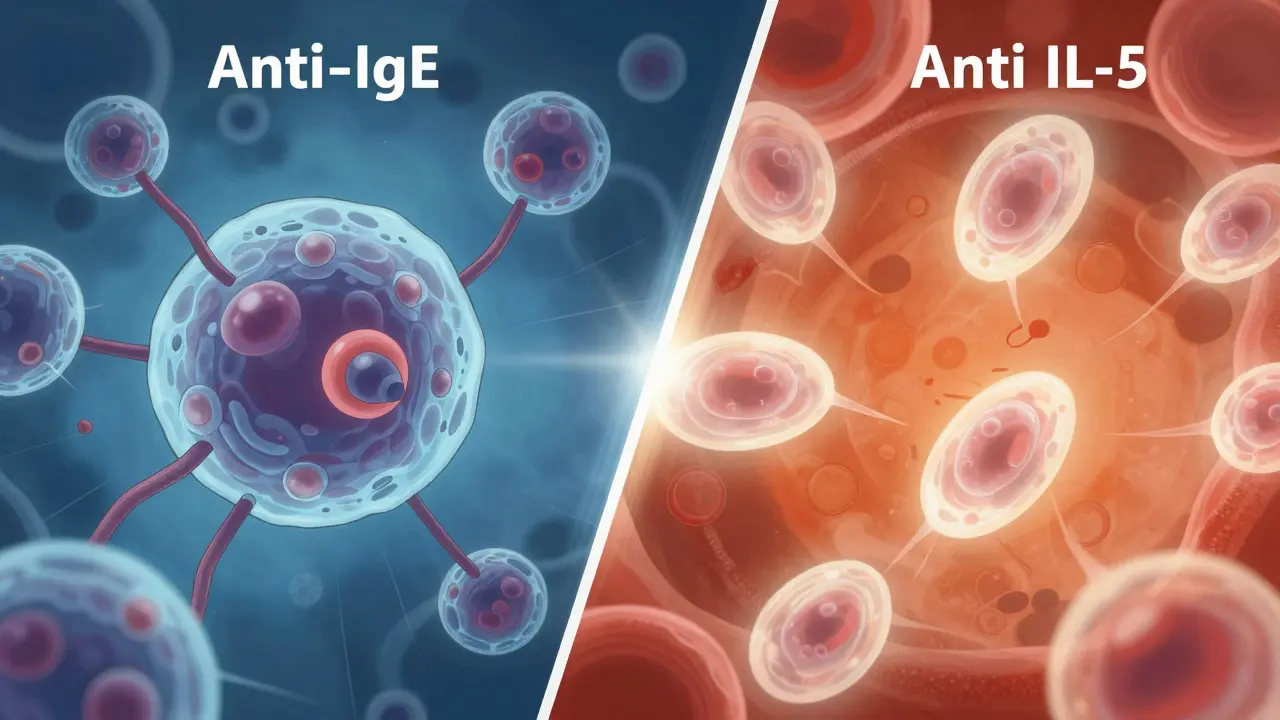
For people with allergic asthma, the culprit is often Immunoglobulin E or IgE, an antibody produced by the immune system that triggers the release of histamine and other chemicals from mast cells during an allergic reaction. When IgE binds to its receptors, it causes the airways to swell and tighten. Anti-IgE therapies step in to block this binding process.
On the other hand, some people have "eosinophilic" asthma. This is driven by Interleukin-5 or IL-5, a cytokine that is responsible for the growth, activation, and survival of eosinophils, a type of white blood cell. When you have too many eosinophils in your lungs, they cause tissue damage and chronic inflammation. Anti-IL-5 biologics either neutralize the IL-5 protein itself or block the receptor on the cell, effectively "starving" the eosinophils and clearing them from your system.
Anti-IgE Therapy: The Allergic Approach
Omalizumab the first biologic approved for severe asthma in 2003, specifically designed to target and neutralize circulating IgE antibodies is the gold standard for allergic asthma. If you've had a positive skin prick test for perennial allergens and your total serum IgE levels fall between 30 and 1500 IU/mL, you might be a candidate.
In the INNOVATE trial, researchers found that omalizumab reduced exacerbations by about 50% for the right patients. It's important to realize that this isn't a "rescue" medication. Because it doesn't interact directly with the cells that cause immediate spasms, you can't use it to stop an active attack. Instead, it lowers the overall baseline of your allergy sensitivity, making you less likely to have an attack in the first place.
Anti-IL-5 Therapy: Managing Eosinophilic Inflammation
When the problem is an overabundance of eosinophils (typically $\ge 150$ cells/$\\mu$L in the blood), doctors turn to the anti-IL-5 family. This group includes Mepolizumab, Reslizumab, and Benralizumab.
While they all target the same pathway, they do it differently. Mepolizumab and Reslizumab bind directly to the IL-5 protein, preventing it from ever reaching the cell. Benralizumab is more aggressive; it targets the IL-5 receptor alpha subunit. This triggers a process called antibody-dependent cellular cytotoxicity, which basically tells the immune system to delete the eosinophils. This leads to a rapid, near-complete depletion of these cells in the blood within 24 hours, which is significantly faster than the other two options.
| Drug Name | Target | Ideal Patient Profile | Administration | Typical Schedule |
|---|---|---|---|---|
| Omalizumab | IgE | Allergic/Atopic Asthma | Subcutaneous | Every 2-4 weeks |
| Mepolizumab | IL-5 (Ligand) | Eosinophilic Asthma | Subcutaneous | Every 4 weeks |
| Reslizumab | IL-5 (Ligand) | Eosinophilic Asthma | Intravenous | Every 4 weeks |
| Benralizumab | IL-5 Receptor | Eosinophilic Asthma | Subcutaneous | Every 8 weeks (after loading) |
Is It Right For You? Biomarkers and Selection
You can't just pick a biologic based on a brochure; you need a blood test. This is the "personalized" part of the therapy. If you have high IgE but low eosinophils, an anti-IL-5 drug likely won't do anything for you. Conversely, if your asthma is purely eosinophilic without an allergic trigger, omalizumab won't be effective.
Doctors typically use a combination of the Asthma Control Test, a history of your ER visits, and specific biomarkers like Fractional Exhaled Nitric Oxide (FeNO) to decide. It's a bit of a puzzle. Real-world evidence suggests that about 30-40% of patients don't see a meaningful response to their first biologic. This is why ongoing monitoring is crucial-if the biomarkers aren't moving and your symptoms aren't improving after 12 to 16 weeks, it might be time to switch the target.
The Real-World Experience: Side Effects and Costs
For many, these drugs are life-changing. It's common to hear patients describe a "lifting of the fog" where they finally stop waking up three times a night gasping for air. A major win is the reduction of oral corticosteroids (like prednisone). Since steroids cause weight gain, bone loss, and mood swings, getting off them is often the primary goal.
However, there are hurdles. The cost is steep, often ranging from $25,000 to $40,000 USD per year, which usually requires a long insurance authorization process. In terms of side effects, injection site reactions are the most frequent-think redness or a slight itch where the needle went in. More serious reactions, like anaphylaxis, are rare (about 1 in 1,000), but the risk is higher if you have a history of severe allergies.

The Future of Asthma Management
We are moving beyond just IgE and IL-5. Newer drugs like Tezepelumab target TSLP, an "upstream" cytokine. This means it hits the inflammatory signal earlier in the chain, potentially working for people regardless of whether they have high eosinophils or allergies.
The next frontier is convenience. Currently, the burden of injections every few weeks is a pain for many. There are phase 3 trials looking at twice-yearly dosing, which would turn a monthly chore into a semi-annual visit. We're also seeing the rise of oral biologic alternatives, like ensifentrine, which offer a way to get targeted therapy without the needles.
How long does it take for biologics to start working?
It varies by person. Some feel a difference within 4 weeks, but for many, the full clinical benefit-like a noticeable drop in exacerbations-takes about 12 to 16 weeks of consistent treatment.
Can I stop using my inhaler if I start a biologic?
No. Biologics are "add-on" therapies. They are designed to work alongside your maintenance inhaled corticosteroids, not replace them. Stopping your inhalers abruptly can actually lead to a severe rebound attack.
What is the difference between an auto-injector and intravenous administration?
Most biologics (like Omalizumab and Mepolizumab) use a subcutaneous auto-injector, which is a quick prick under the skin that you can eventually do yourself at home. Reslizumab is different; it must be given as an IV infusion in a clinical setting, which takes longer and requires medical supervision.
Are biologics safe for long-term use?
Current data shows they are generally safe and well-tolerated. However, most large-scale studies have focused on windows of 5 years or less. Long-term safety beyond a decade is still being monitored in real-world cohorts.
Why do some people fail to respond to these drugs?
Asthma is complex. If your inflammation is driven by a pathway that the drug doesn't target (for example, using an anti-IL-5 drug when your asthma is actually non-eosinophilic), the medication won't have any target to bind to, resulting in no clinical improvement.
Next Steps for Patients
If you feel your asthma is "uncontrollable" despite using your inhalers correctly, start by keeping an exacerbation diary. Note every time you use your rescue inhaler more than twice a day or visit a clinic. Bring this data to an allergist or pulmonologist and ask for a biomarker panel (specifically IgE and blood eosinophil counts). This is the only way to determine if you are a match for these therapies. If insurance is a barrier, check for manufacturer co-pay assistance programs, as most biologic companies offer these to make the drugs more accessible.