
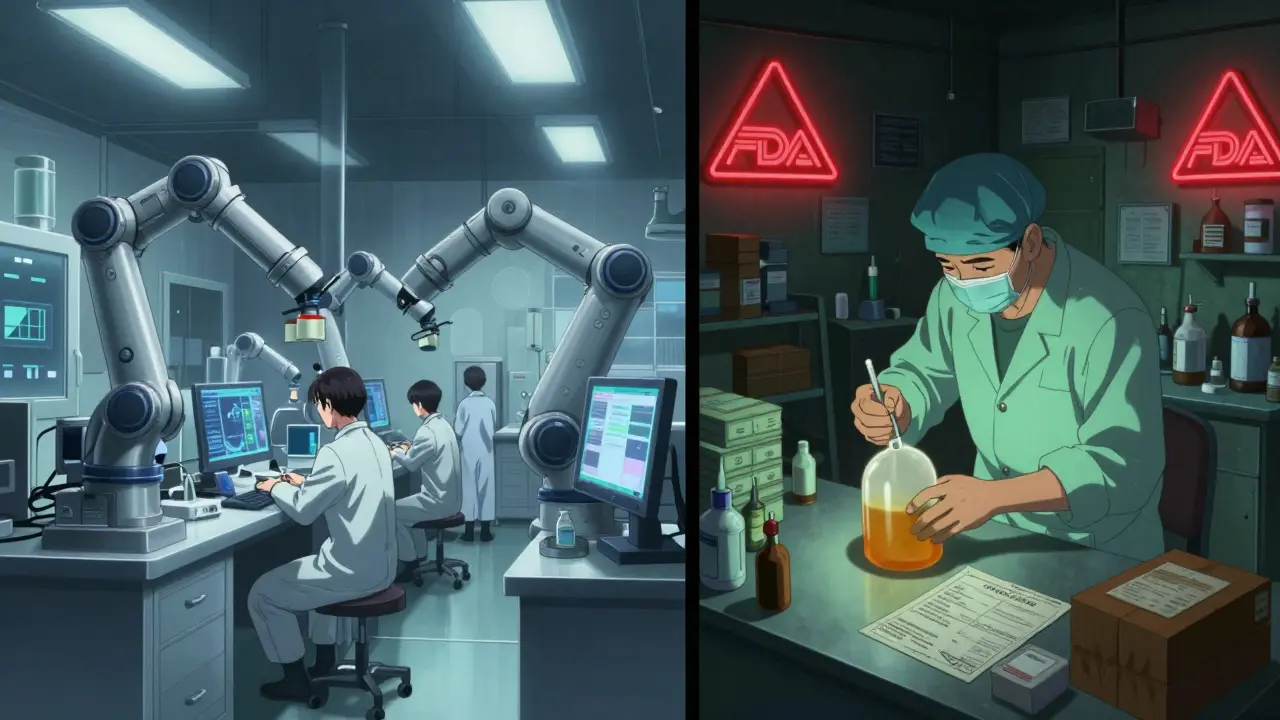
Why Your Medicine Might Be Riskier Than You Think
It’s 2026, and more than half of the pills, syringes, and medical devices used in the U.S. are made overseas. That’s not a problem-unless the factory making them cuts corners. In 2024, the FDA found that foreign manufacturing was behind 62% of all drug recalls, even though these facilities only produced 43% of the total volume. The gap isn’t accidental. It’s systemic.
Companies offshore production to save money. Labor costs in China, India, and Vietnam can be 30-45% lower than in the U.S. But those savings come with hidden dangers. A single batch of contaminated active ingredient can trigger a nationwide recall. A fake certificate of analysis can slip past inspectors. A worker replacing medical-grade silicone with industrial-grade material? That’s happened. And it’s not rare.
The Hidden Crisis in Drug Manufacturing
The FDA’s 2025 inspection data tells a chilling story. In Chinese pharmaceutical plants alone, 47% received formal warnings (Form 483s) for quality violations. Compare that to 29% in U.S. facilities. Why the gap? One major reason: most inspections in China are announced in advance. Brookings Institution found that 78% of FDA inspections in China were scheduled, while only 5% of domestic inspections were. That’s not oversight-it’s a loophole.
Take Wuhu Nuowei Chemistry Co., Ltd. The FDA issued a warning letter in February 2025 after discovering their batches contained impurity levels far above U.S. limits. They didn’t just miss a step-they ignored the entire system. That’s not an isolated case. In 68% of inspected Chinese facilities, materials were swapped out for cheaper alternatives. In 42%, critical processes weren’t validated. In 29%, documents were forged. These aren’t mistakes. They’re patterns.
AI Isn’t Saving the Day-Yet
You might think technology is fixing this. After all, AI-powered visual inspection systems now detect defects with 99.2% accuracy, far better than human inspectors at 85-90%. But here’s the catch: only 22% of Chinese manufacturers have actually installed these systems. Most still rely on workers with clipboards, checking samples by eye, often under pressure to meet deadlines.
Deloitte’s 2025 report shows that companies using AI, IoT sensors, and blockchain traceability reduce defects by 33%. But those are the exceptions. The majority? They’re still using 2010s-era quality control. And when a factory is struggling financially-many are, after years of pandemic disruptions and rising energy costs-the temptation to cut corners becomes overwhelming.

China’s Dual Reality: High-Tech Factories and Desperate Suppliers
The Chinese government says it’s fixing things. The “Made in China 2025” initiative, launched in 2015, promised a revolution in quality. Some factories have transformed. They’ve hired engineers, installed real-time monitoring, trained staff in ISO 9001 standards. Dr. Li Wei from Tsinghua University says 73% of surveyed manufacturers now use advanced analytics.
But that’s only part of the picture. Harris Sliwoski’s 2025 report on China’s manufacturing sector paints a darker truth: “Quality issues have evolved from simple errors to sophisticated, desperate survival tactics.” In other words, some factories are now running coordinated fraud. They’re hiding non-compliant batches in separate warehouses. They’re using fake certificates. They’re bribing inspectors. One German importer lost $1.2 million after Sinosure, China’s state-backed export insurer, sided with the supplier-even though the goods were clearly substandard.
The result? A fractured system. On one side: high-end factories making precision medical devices for global brands. On the other: struggling suppliers cutting costs to survive. And the buyers? Often, they don’t know which is which until it’s too late.
Why Southeast Asia Isn’t the Easy Fix
Many companies are now shifting production to Vietnam or India, hoping for better quality. But the data doesn’t support that hope.
Vietnam’s quality metrics improved 18% since 2022, according to Gembah’s 2025 report. That’s promising. But it’s still a small base. Meanwhile, Indian manufacturers accounted for 34% of all FDA drug import alerts in 2024-even though they only make up 25% of foreign facilities. Why? Systemic weaknesses in quality management. Poor documentation. Lack of trained personnel. The same problems, just in a new country.
The EU’s approach is different-and it works. Their Qualified Person (QP) system requires a certified professional, physically located in the EU, to personally sign off on every batch of medicine before it’s sold. That person is legally liable. If something goes wrong, they lose their license. That’s accountability. The result? A 22% drop in quality failures compared to imports from countries without similar rules.
What Companies Are Doing Right
There are success stories. One Minnesota medical device company slashed defect rates from 12.7% to 0.8% between 2023 and 2025. How? They built a “China-specific quality triad.”
- A full-time local quality manager, hired directly by them-not through a middleman.
- Blockchain traceability for every component, from raw material to final packaging.
- Third-party auditors who show up unannounced, twice a month.
They didn’t save money. They spent more-$18,500 per year per facility on training, audits, and tech. But they avoided recalls, lawsuits, and brand damage. That’s the real cost of bad quality: it’s not the price of a batch. It’s the price of your reputation.

The New Rules for Overseas Manufacturing
If you’re importing products from overseas in 2026, here’s what you need to do-or risk losing everything.
- Vet suppliers like a regulator. Don’t rely on Alibaba reviews. Conduct on-site audits. Interview the quality team. Ask for three references from past clients-and call them. Take 8-12 weeks. No shortcuts.
- Write contracts with teeth. Vague quality standards cause 58% of recoverable losses, according to Harris Sliwoski. Define exact tolerances. Specify materials. List consequences for non-compliance. Include audit rights.
- Insist on unannounced inspections. If your supplier says they can’t handle surprise visits, walk away. The FDA is starting to do this. You should too.
- Use third-party verification. Hire a local firm to test random batches. Don’t trust the supplier’s lab. Send samples to an independent lab in Singapore, Germany, or the U.S.
- Track everything digitally. Use blockchain or cloud-based systems to log every step: material receipt, production batch, test results, shipping. Paper records can be altered. Digital trails can’t.
The Bigger Picture: Regulation Is Catching Up
The FDA is changing. On May 6, 2025, Commissioner Marty Makary announced a major shift: “Parity inspections.” That means foreign facilities will be inspected the same way as U.S. ones-with no advance notice. By late 2025, 40% of foreign inspections will be unannounced. By 2027, that number will hit 75%.
President Trump’s May 2025 executive order also raised user fees for foreign manufacturers, increasing compliance costs by 18-25%. That’s going to force many low-end suppliers out of business. But it’s also creating a new divide: the companies that can afford to comply, and the ones that can’t.
Meanwhile, “friend-shoring” is growing. 41% of manufacturers surveyed by Deloitte plan to move production to allied countries like Mexico, Poland, or India by 2027. But new locations mean new risks. New suppliers mean new learning curves. And if you skip the vetting? You’re just trading one set of problems for another.
What This Means for You
If you’re a patient, a pharmacist, or a doctor-you’re not just trusting the brand on the bottle. You’re trusting a factory you’ve never seen, run by people you’ve never met, in a country with different laws.
That’s not a system built for safety. It’s a system built for speed and cost. And right now, the people paying the price are the ones who can’t afford to.
The good news? You don’t have to accept it. Demand transparency. Ask your supplier: “How do you verify quality? Can I see your audit reports? Do you do unannounced inspections?” If they hesitate, walk away.
The future of global manufacturing won’t be about the cheapest price. It’ll be about the most trustworthy system. And in 2026, that’s worth more than any savings on labor.
Why are foreign drug manufacturing quality issues getting worse in 2026?
Quality issues are worsening because many overseas factories are under financial pressure, leading to deliberate shortcuts like material substitution, falsified documentation, and skipped validation steps. While some high-end manufacturers are investing in AI and compliance, the majority-especially smaller suppliers-are cutting corners to survive. The FDA’s historically low rate of unannounced inspections in countries like China created a false sense of security, but new policies are now closing those gaps.
Is Made in China 2025 improving quality?
It’s mixed. Large, government-backed manufacturers are upgrading with AI, automation, and training-some achieving near-perfect compliance. But thousands of smaller suppliers, especially those not part of the “Made in China 2025” program, are struggling. Many are using fraud tactics to meet orders. So while the initiative has lifted the top tier, it hasn’t fixed the broader system. The gap between elite factories and desperate ones is wider than ever.
Are Indian and Vietnamese factories safer than Chinese ones?
Not necessarily. India accounts for 34% of FDA drug import alerts despite making only 25% of foreign products. Vietnamese factories are improving, but they’re still early in their quality journey. The problem isn’t just location-it’s oversight. A factory in Vietnam with no trained QA staff and no unannounced audits is just as risky as one in China. Location matters less than systems.
What’s the most effective way to prevent quality failures in overseas production?
The most effective method is the “quality triad”: 1) A local, company-hired quality manager on-site; 2) Real-time digital traceability (blockchain or cloud logs); and 3) Unannounced third-party audits. Companies using this system reduce defects by over 90%. It’s expensive, but cheaper than a recall, lawsuit, or lost brand trust.
Can AI solve overseas quality problems?
AI can detect defects with 99.2% accuracy, far better than humans. But it only works if it’s installed-and only 22% of Chinese factories have it. AI can’t fix a culture of fraud. If a factory hides bad batches or forges test results, AI won’t help unless it’s connected to real-time production data. The tech is powerful, but it’s useless without accountability and transparency.
Should I stop manufacturing overseas altogether?
No-but you must stop trusting suppliers blindly. The cost savings are real, but so are the risks. The key is to invest in oversight: on-site staff, digital tracking, and surprise audits. Companies that do this thrive. Those that don’t get burned. It’s not about where you make things-it’s how you control quality.


