
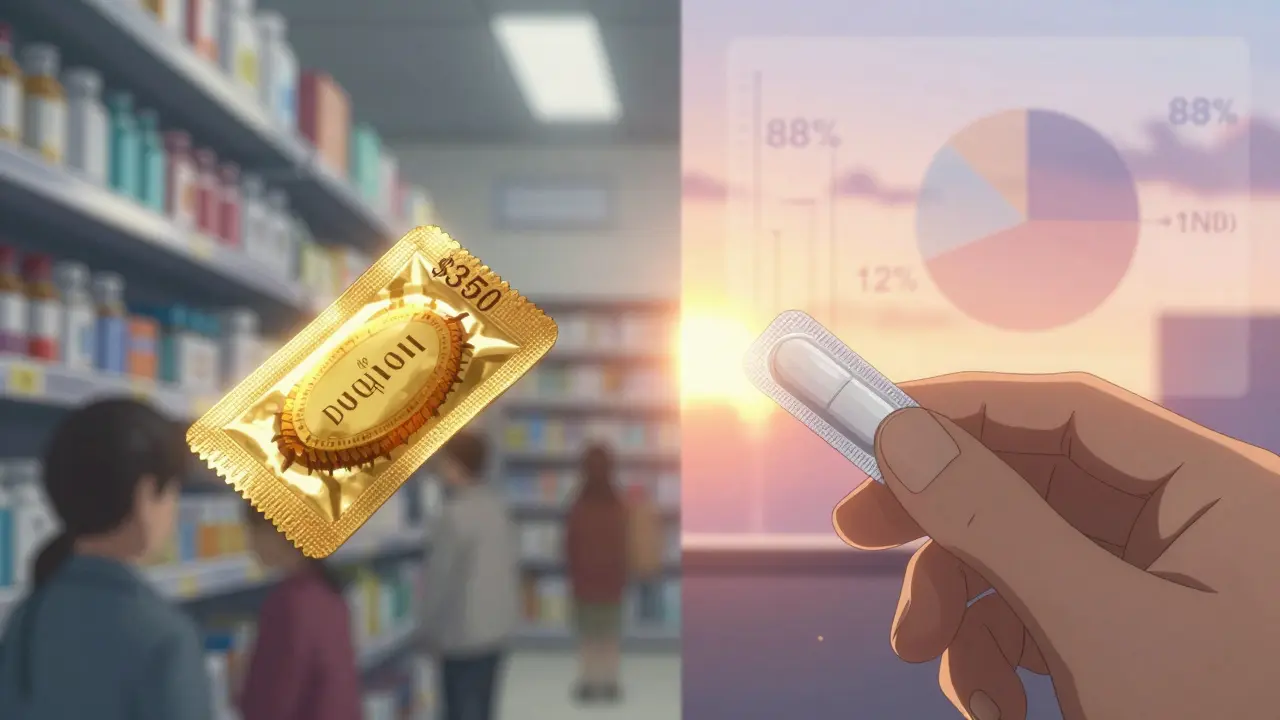
Every year, Americans spend over $650 billion on prescription drugs. That’s more than any other country in the world. But here’s the surprising part: 90% of all prescriptions filled are for generic drugs - and they make up just 12% of total spending. Meanwhile, brand-name drugs, which make up only 10% of prescriptions, account for 88% of the cost. This isn’t a glitch. It’s the power of generics at work.
What Exactly Are Generic Drugs?
Generic drugs are exact copies of brand-name medications. They contain the same active ingredient, in the same strength, and work the same way in your body. The FDA requires them to meet the same strict standards for safety, purity, and effectiveness. The only differences? The name, the color, the shape, and the inactive ingredients - like fillers or dyes - which don’t affect how the drug works. The key to their low cost? No need to repeat expensive clinical trials. When a brand-name drug’s patent expires, generic manufacturers can file an Abbreviated New Drug Application (ANDA) with the FDA. This lets them prove their version is bioequivalent - meaning it behaves the same in your body - without starting from scratch. The process takes about 10-12 months and costs around $1 million per application. Compare that to the $2.6 billion and 10-15 years it takes to develop a new brand drug. That’s why generics can be priced 80-85% lower.The Real Numbers Behind the Savings
In 2024, Americans filled 3.9 billion generic prescriptions. That’s nearly 4 billion times a year people chose a generic over a brand-name drug. And those choices saved the system $98 billion in direct drug costs. Meanwhile, brand-name drugs - only 435 million prescriptions - cost $700 billion. That’s a 7-fold difference in spending for just one-tenth the volume. Cumulative savings since 2000? Over $445 billion in 2023 alone. That’s enough to cover the annual healthcare costs for millions of people. For patients, it’s even more personal. A person taking a $350-a-month brand-name insulin? Switching to generic insulin lispro drops the cost to $25. That’s not a theoretical saving - it’s the difference between taking your medicine and skipping doses.How Generics Compare to Other Cost-Saving Strategies
Many people think drug price negotiations or step therapy are the biggest levers for cutting costs. But they don’t come close. - Medicare drug price negotiations saved 38-79% on 10 drugs in 2026 - impressive, but limited to just those 10 drugs and only for Medicare patients. - Step therapy, where you try cheaper drugs first, saves about 12-15% per treatment episode. - Generic substitution? It drops prices by 80-85% the moment the first generic hits the market. The Congressional Budget Office found that generic competition reduces prices by 90% within a year of patent expiry - nearly double the impact of Medicare negotiation. And it’s not just about price. Generics work. A review of 1.2 million patient reviews on Drugs.com showed generic drugs scored 4.1 out of 5 for overall satisfaction - nearly identical to brand-name drugs at 4.3. Efficacy ratings were the same: 4.2 out of 5. But affordability? Generics scored 4.5. Brands? 2.3.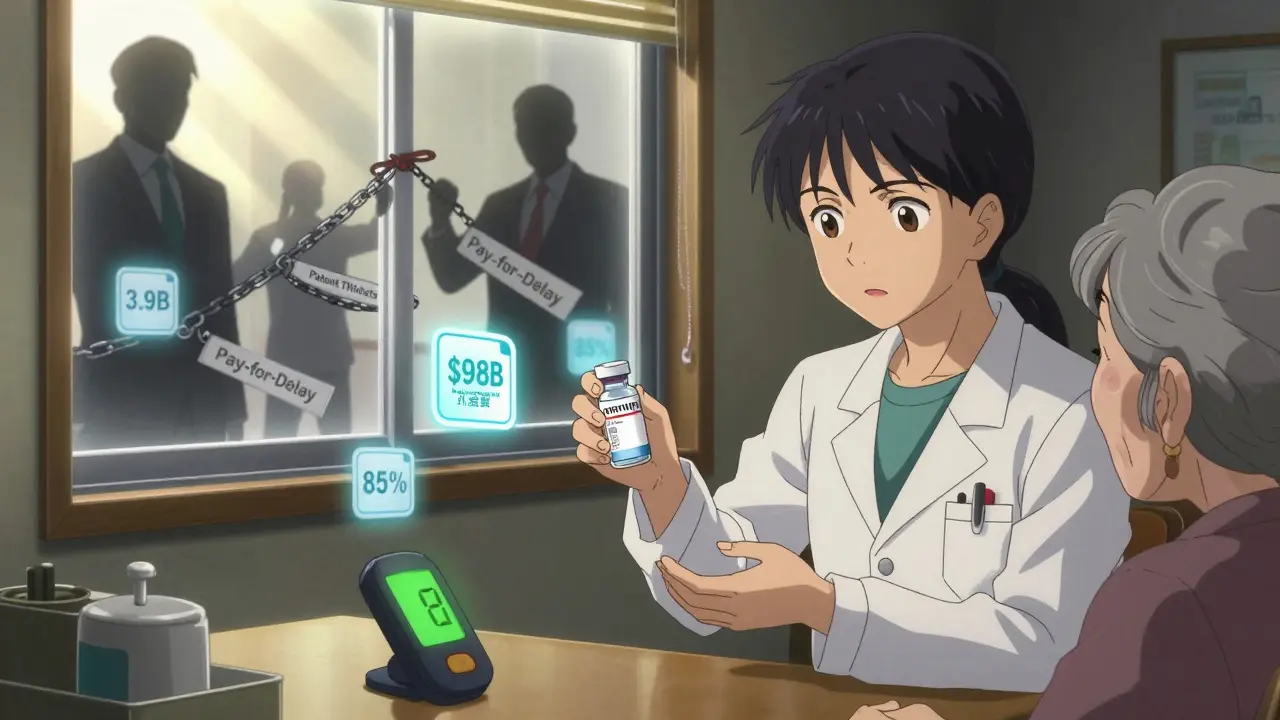
Why Aren’t Generics Used More? The Hidden Barriers
If generics are this effective, why do so many people still pay more? Because the system isn’t designed to make them easy to use. One major roadblock? Patent thickets. Brand manufacturers file dozens - sometimes over 140 - patents on a single drug. These aren’t always about the medicine itself. They cover delivery systems, packaging, or minor formulation tweaks. The goal? To delay generics. The result? On average, it takes 28 months after patent expiry for the first generic to appear. Sometimes longer. Then there’s pay-for-delay. When a brand company pays a generic maker to stay out of the market. The FTC found these deals delay generic entry by 17 months on average - costing consumers $3.5 billion a year. Even when generics are approved, pharmacy benefit managers (PBMs) often block them. Some commercial plans charge higher copays for generics than for brand-name drugs - if the brand’s rebate to the PBM is bigger than the price difference. That’s right: you pay more for the cheaper drug. And then there’s the “biosimilar void.” Biologics - complex drugs made from living cells - are the fastest-growing segment of drug spending. They make up 51% of total drug costs but only 5% of prescriptions. Yet 90% of biologics set to lose patent protection in the next decade have no biosimilar in development. In Europe, biosimilars are used in 70-85% of cases. In the U.S.? Just 25-30%. Why? Rebates, confusion, and fear.When Generics Don’t Work - And Why
Generics aren’t perfect. There are limits. Narrow therapeutic index drugs - like warfarin, levothyroxine, or phenytoin - require very precise dosing. Even tiny differences in absorption can cause problems. Some patients report side effects or loss of symptom control after switching. The FDA says these drugs are still therapeutically equivalent - but real-world experience shows some people are sensitive. That’s why 12 states require doctors to specifically authorize substitution for these drugs. Also, complex delivery systems are hard to copy. Inhalers, injectables, and topical creams have physical properties that are tough to replicate exactly. Bioequivalence testing for these isn’t just about blood levels - it’s about how the drug is delivered to the tissue. That’s why fewer generics exist for these types of drugs. And then there’s the supply chain. About 80% of active pharmaceutical ingredients (APIs) are made in India and China. During the pandemic, 300+ drug shortages hit the U.S., mostly generics. Quality control issues, factory shutdowns, and geopolitical instability make supply unpredictable.What Patients Actually Experience
Real people feel the impact every day. On Reddit, a user wrote: “My mom switched from brand-name Humalog to generic insulin lispro. Her blood sugar didn’t change. Her out-of-pocket cost dropped from $350 to $25. She stopped rationing her insulin.” GoodRx’s 2024 report found that 68% of patients skip or split pills when generics aren’t available. Among Medicare Part D users, 42% reported skipping doses due to cost - but only 12% did so with generics. But it’s not all smooth. The FDA received 1,247 adverse event reports in 2023 tied to generic substitutions. Most were gastrointestinal issues - caused by different inactive ingredients. One patient might react to a dye in one generic but not another. That’s why some doctors still prescribe brands - not because they’re better, but because they’re predictable.
How to Use Generics Wisely
You don’t need to be a pharmacist to use generics effectively.- Ask your doctor: “Is there a generic version?” If they say no, ask why. It might be habit, not science.
- Check the FDA’s Orange Book - it lists all approved generics and their therapeutic equivalence codes. ‘A’ means it’s interchangeable. ‘B’ means it’s not.
- Use tools like GoodRx or SingleCare to compare prices. Sometimes the brand is cheaper than the generic if the PBM rebate is high.
- If you’re on a narrow therapeutic index drug like levothyroxine, stick with the same generic brand. Don’t switch unless your doctor approves.
- Know your insurance plan. Some commercial plans penalize generics. If your copay is higher for the generic, ask your insurer why.
The Future of Generics
The Inflation Reduction Act capped insulin at $35/month for Medicare - and that pushed brand manufacturers to lower prices across the board. Generic manufacturers didn’t need to do anything. The market changed because of policy. The FDA’s new Biosimilars Action Plan aims to cut approval times by 50%. That’s critical. Without biosimilars, the cost of treating cancer, autoimmune diseases, and other chronic conditions will keep rising. But the biggest opportunity? Fixing the system that protects brand monopolies. Ending pay-for-delay deals. Limiting patent thickets. Making sure PBMs don’t profit from patient confusion. The data is clear: generics are the most powerful tool we have to control drug spending. They’re safe. They’re effective. And they’re affordable. The question isn’t whether they work. It’s why we still make it so hard for patients to use them.Why This Matters for Everyone
Drug spending isn’t just a hospital or insurance problem. It’s a family budget problem. It’s whether someone can afford their blood pressure medicine. Whether a diabetic can refill their insulin. Whether a senior chooses between food and their pills. Generics don’t just lower costs - they make healthcare possible. And the more we understand how they work, the better we can demand a system that puts patients first - not profits.Are generic drugs as safe and effective as brand-name drugs?
Yes. The FDA requires generic drugs to have the same active ingredient, strength, dosage form, and route of administration as the brand-name version. They must also prove bioequivalence - meaning they work the same way in your body. Studies show no meaningful difference in safety or effectiveness. Over 90% of prescriptions filled in the U.S. are generics, and they’ve been used safely for decades.
Why are generic drugs so much cheaper?
Generic manufacturers don’t have to repeat expensive clinical trials. Once a brand-name drug’s patent expires, generics can use the existing safety and efficacy data. They only need to prove their version is bioequivalent, which costs about $1 million and takes less than a year - compared to $2.6 billion and 10-15 years for a new brand drug. That’s why generics can be 80-85% cheaper.
Can I switch from a brand-name drug to a generic without my doctor’s approval?
In most cases, yes - pharmacists are allowed to substitute generics unless the doctor writes “dispense as written” or “no substitution.” But for narrow therapeutic index drugs like warfarin or levothyroxine, 12 states require explicit permission from the prescriber. Always check with your pharmacist or doctor if you’re unsure.
Why does my generic drug look different than the brand?
By law, generic drugs can’t look exactly like the brand-name version - that would violate trademark rules. So they may have a different color, shape, or size. But the active ingredient is identical. The differences are only in inactive ingredients like fillers or dyes, which don’t affect how the drug works.
Why do some people have side effects after switching to a generic?
Sometimes, it’s due to inactive ingredients - like lactose, dyes, or preservatives - that can trigger reactions in sensitive individuals. The FDA received over 1,200 reports of adverse events linked to generic substitutions in 2023, mostly gastrointestinal issues. For most people, this is rare. But if you notice new symptoms after switching, talk to your doctor. You may need to switch back or try a different generic brand.
Do biosimilars work the same way as generics?
Biosimilars are similar to generics, but for complex biologic drugs made from living cells - like insulin or rheumatoid arthritis treatments. They’re not exact copies, but they’re proven to have no clinically meaningful differences in safety or effectiveness. They’re typically 15-35% cheaper than the brand-name biologic. Adoption in the U.S. is low (25-30%) compared to Europe (70-85%) because of insurance rebates and provider hesitation.
What’s the biggest barrier to more generic use?
The biggest barrier isn’t science - it’s money. Patent thickets, pay-for-delay deals, and pharmacy benefit managers (PBMs) that profit from brand-name rebates often block or discourage generic use. Even when generics are available, some insurance plans charge higher copays for them. That’s why patients sometimes pay more for the cheaper drug.
Will Medicare negotiation replace the need for generics?
No. Medicare negotiation saves money on a limited number of drugs - only 10 in 2026, expanding to 30 annually by 2029. But generics work on every off-patent drug, every day, for everyone. The Congressional Budget Office says generic competition saves more per drug than negotiation, especially for widely used medications. Generics are the foundation of cost control - negotiation is just a supplement.


