

Macrolide Antibiotic Risk Calculator
Patient Risk Assessment
Antibiotic Selection
When you take an antibiotic like azithromycin or clarithromycin for a sinus infection or bronchitis, you’re probably thinking about clearing up the cough or fever-not your heart. But for some people, these common drugs can quietly disrupt the heart’s rhythm, leading to a dangerous condition called QT prolongation and, in rare cases, a life-threatening arrhythmia called Torsades de pointes. This isn’t theoretical. It’s documented in medical journals, flagged by the FDA, and tracked in real-world patient data. If you’re over 65, have heart disease, take other medications, or are a woman, your risk isn’t zero. And that’s something every patient and prescriber needs to understand.
What Exactly Is QT Prolongation?
Your heart beats because of electrical signals moving through muscle cells. After each beat, the heart resets-this reset phase is called repolarization. The QT interval on an ECG measures how long that reset takes. If it’s too long, the heart muscle doesn’t recover properly, and extra, abnormal electrical signals can fire off. That’s QT prolongation. When this happens, it can trigger Torsades de pointes-a chaotic, fast heartbeat that can turn into cardiac arrest if not treated immediately. Macrolide antibiotics like azithromycin, clarithromycin, and erythromycin interfere with a specific potassium channel in heart cells called hERG. This channel helps the heart reset after beating. When macrolides block it, repolarization slows down, and the QT interval stretches. It’s not magic-it’s basic pharmacology. But the danger isn’t the same for everyone. For most healthy people, the effect is small and harmless. For others, even a 20-millisecond increase can be enough to tip the balance.Which Macrolides Carry the Highest Risk?
Not all macrolides are created equal when it comes to heart risk. Clarithromycin is the most dangerous. It doesn’t just block the hERG channel-it also shuts down a liver enzyme called CYP3A4, which breaks down other drugs. That means if you’re taking clarithromycin and another medication that prolongs QT-like a statin, antidepressant, or antiarrhythmic-the levels of both drugs can spike in your blood. This double hit makes arrhythmias much more likely. Erythromycin is a close second. It’s a weaker blocker of the hERG channel, but it causes serious stomach upset in many people. Vomiting and diarrhea lead to low potassium levels, which further prolongs the QT interval. It’s a one-two punch: direct heart effect plus electrolyte imbalance. Azithromycin used to be considered the safe choice. It doesn’t interfere much with liver enzymes, and lab tests showed weaker hERG blockade. But real-world data tells a different story. A 2012 study of over 1.3 million patients found azithromycin was linked to a 2.85 excess number of cardiovascular deaths per 1,000 courses compared to amoxicillin. The risk was highest in the first five days of treatment-right when people are most likely to be taking it. Even if your QT interval looks normal on paper, azithromycin can still push it over the edge if you have other risk factors.Who’s Most at Risk?
The FDA and American Heart Association have laid out six clear risk factors that turn a low-risk drug into a dangerous one:- Female sex-68% of all TdP cases occur in women, likely due to naturally longer baseline QT intervals.
- Age over 65-risk doubles. Older hearts are more sensitive to electrical disruption.
- Baseline QTc over 450 ms-already prolonged? Adding a macrolide can push you into danger zone.
- Other QT-prolonging drugs-each additional drug increases risk by 80%. Common ones include fluoroquinolones, antifungals, antidepressants, and anti-nausea meds.
- Low potassium or magnesium-hypokalemia triples your risk. Diuretics, vomiting, or poor diet can cause this.
- Heart failure or structural heart disease-this raises risk more than fivefold. Damaged hearts don’t handle electrical stress well.
Here’s the hard truth: many people don’t know they have a hidden risk. About 5-20% of those who develop TdP after taking these drugs have a silent form of congenital long QT syndrome. No symptoms. No diagnosis. Just a genetic quirk that only shows up under stress-like a macrolide antibiotic.
What Should Doctors and Patients Do?
The good news? You don’t need to avoid macrolides entirely. But you need to be smart about it.- If you’re over 65, have heart disease, or take other medications, ask your doctor for a baseline ECG before starting a macrolide.
- If your QTc is above 470 ms in men or 480 ms in women, avoid macrolides altogether.
- If your QTc increases by more than 60 ms from baseline during treatment, stop the drug immediately.
- Check your potassium levels if you’re on diuretics or have had recent illness.
- Ask if there’s a safer alternative-like doxycycline, amoxicillin, or cefdinir-for your infection.
Clarithromycin has a black box warning in the U.S. for QT prolongation. Azithromycin doesn’t-but that doesn’t mean it’s safe. The label says “use with caution.” That’s code for: “We know this can kill people. Don’t ignore the risk factors.”
Real-World Impact: How Prescribing Has Changed
Since the 2012 study linking azithromycin to heart deaths, and the FDA’s 2013 warning, prescribing patterns have shifted. Between 2010 and 2020, macrolide prescriptions in the U.S. dropped by nearly 19%. Clarithromycin use fell 23.5% among Medicare patients after the AHA’s 2020 classification. Azithromycin still makes up 65% of all macrolide prescriptions-not because it’s the safest, but because doctors still believe it’s safer than the others. But that belief is being tested. The 2020 COVID-19 pandemic saw azithromycin used with hydroxychloroquine in many hospitals. The combination didn’t work against the virus-but it did push QT intervals up by an average of 26.2 milliseconds. Several patients developed arrhythmias. That episode showed how quickly a common drug can become dangerous when combined with another.
New Tools to Help Manage Risk
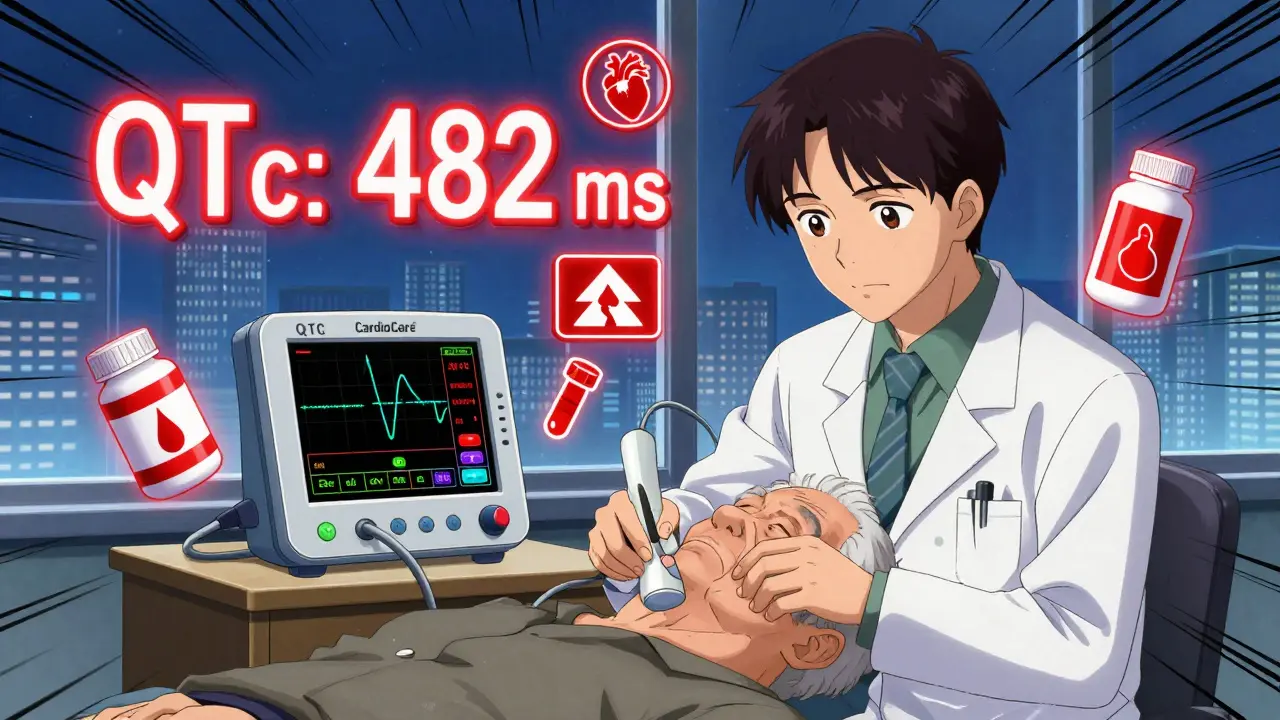
The medical community is responding with better tools. In 2023, the FDA approved a handheld ECG device called CardioCare QT Monitor. It gives doctors an accurate QTc reading in under a minute at the point of care. No waiting for a lab. No guesswork. Also in 2024, researchers at Brigham and Women’s Hospital launched the Macrolide Arrhythmia Risk Calculator (MARC). It takes 12 inputs-age, sex, kidney function, medications, baseline QT, electrolytes-and calculates your personal risk of TdP. It’s 89% accurate in validation studies. This isn’t science fiction-it’s in use in some hospitals now. Even the drugs themselves are being redesigned. A new macrolide called solithromycin was developed to block bacteria without blocking hERG channels. In trials, it caused 78% less QT prolongation than clarithromycin. But development was stopped in 2022 because it caused liver damage. The lesson? You can’t just tweak one risk-you have to manage the whole system.What’s Next?
The future lies in personalization. Researchers are now studying genetic variants in the hERG gene. Early data shows about 15% of people carry a mutation that makes them four times more sensitive to macrolide-induced QT prolongation. Imagine a future where your doctor runs a quick genetic test before prescribing azithromycin-and knows whether you’re in the 15% who could be at serious risk. In the meantime, clinical trials are testing whether drugs like nicorandil-normally used for angina-can counteract QT prolongation. Early results show a 32.7-millisecond reduction in QTc compared to placebo. That’s a promising path.Bottom Line: Know Your Risk, Don’t Fear the Drug
Macrolide antibiotics are effective. They save lives. But they’re not risk-free. The danger isn’t in the drug itself-it’s in the combination of factors around you: your age, your other meds, your heart health, your electrolytes, your genes. If you’re healthy, young, and taking azithromycin for a simple infection, your risk is very low. But if you’re over 65, on diuretics, have heart failure, or take antidepressants? Ask your doctor for an ECG. Ask if there’s a better option. Don’t assume azithromycin is safe just because it’s popular. And if you’ve ever had unexplained fainting or a family history of sudden cardiac death before age 50-tell your doctor. That could be the most important detail you never thought to mention.Antibiotics aren’t harmless. They’re powerful tools-and like any tool, they can hurt you if you don’t use them with care.


