
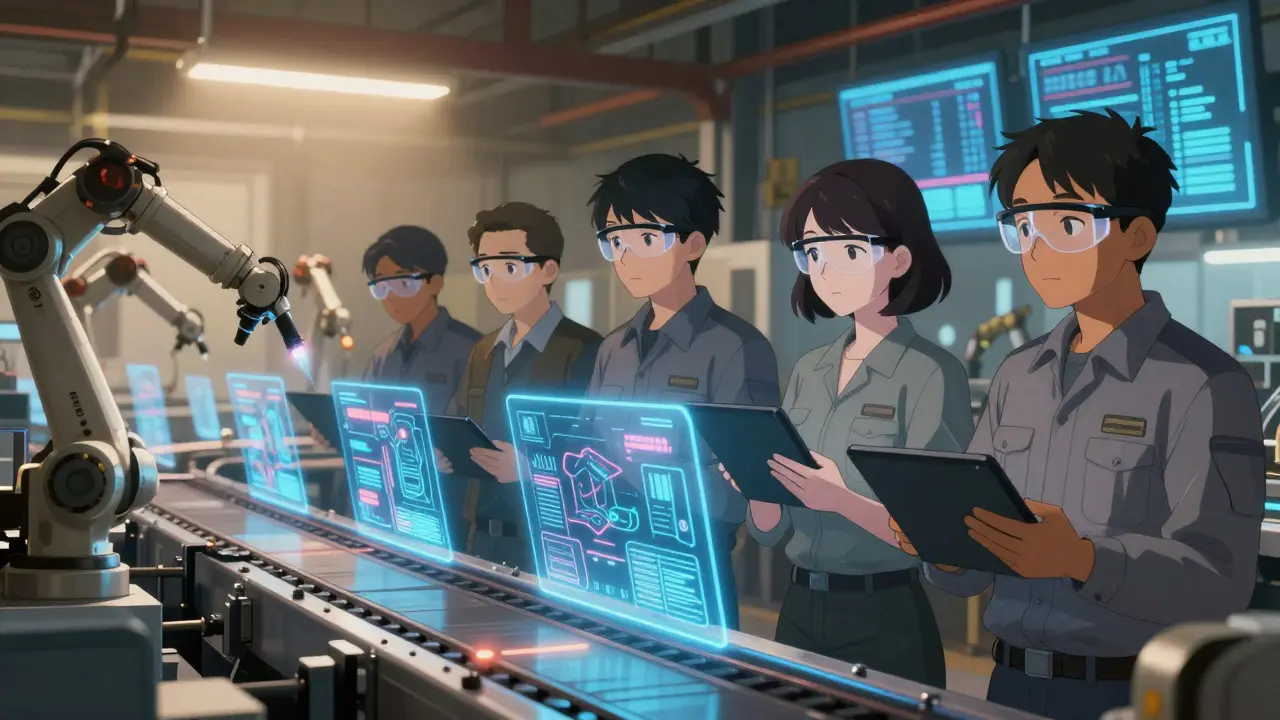
What Manufacturing Staff Actually Need to Know Today
It’s 2026, and the factory floor isn’t what it used to be. Machines talk to each other. Robots handle precision tasks. Workers don’t just push buttons-they monitor screens, interpret data, and fix problems before they happen. If you’re hiring or training manufacturing staff, the old rules don’t apply anymore. A high school diploma might get someone in the door, but it won’t keep them there. The real edge? Qualified, certified, and continuously trained workers.
Entry-Level Isn’t Just a Diploma Anymore
Most manufacturers still say they’ll hire someone with just a high school diploma or GED. And yes, 92% of them do. But here’s the catch: those hires are 37% more likely to quit within a year. Why? Because without basic training, they’re overwhelmed. They don’t know how to read a blueprint. They don’t understand tolerances. They get scared when a machine flashes an error code.
Entry-level doesn’t mean untrained. It means starting with the fundamentals: safety, basic machine operation, and quality checks. The Certified Production Technician (CPT) credential from the Manufacturing Skill Standards Council (MSSC) is the gold standard here. It’s not a degree-it’s a stackable credential. Workers earn it in weeks, not years. And it covers four critical areas: safety, quality practices, manufacturing processes, and maintenance awareness. Companies that require CPT for new hires report 28% higher productivity. That’s not magic. That’s structure.
The Certifications That Actually Move the Needle
Not all certifications are created equal. Some are just expensive paper. Others change careers.
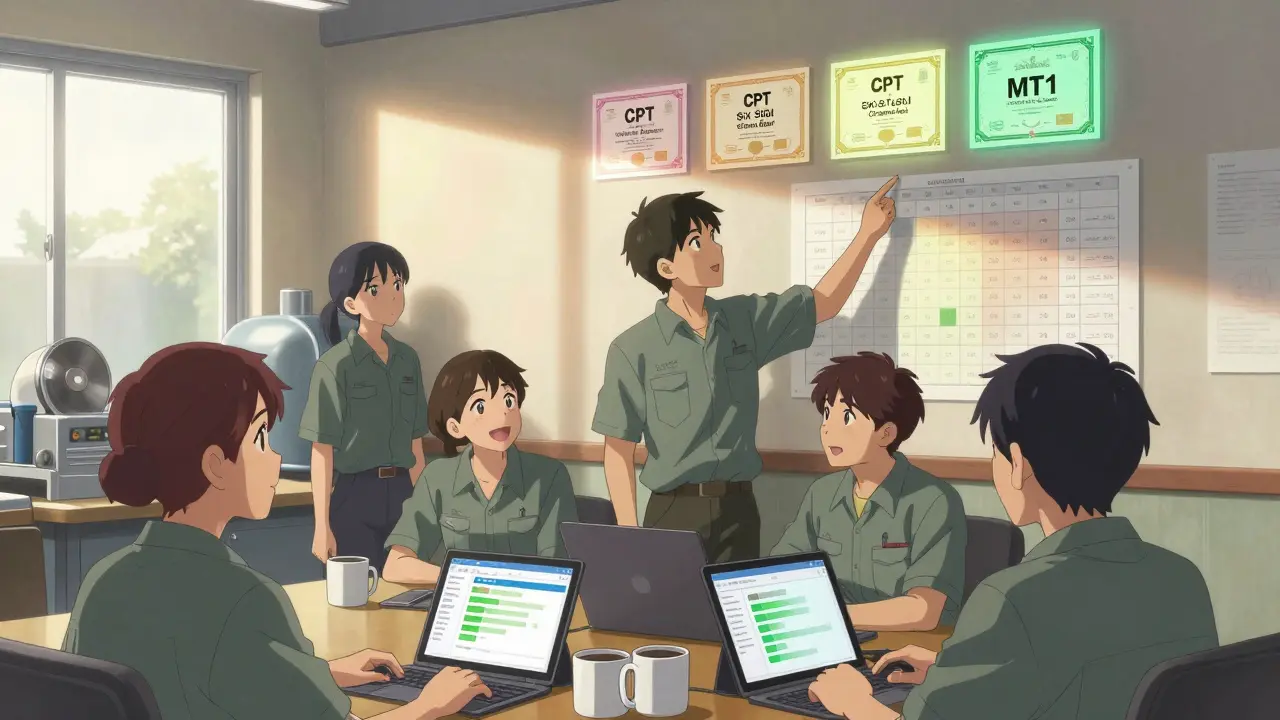
- CPT (Certified Production Technician) - The baseline. Required by over 1,200 manufacturers nationwide. Costs under $200 to test. Valid for life. Covers what every worker needs to know on day one.
- Six Sigma Belts - Green Belt? That’s the sweet spot for supervisors and lead operators. Requires 100-160 hours of training and a real project. Green Belts earn an average of $85,000. Black Belts? $110,000. But you need to earn it. ASQ and IASSC are the main providers. And yes, the new 2025 versions now require basic Python and SQL skills.
- MT1 (Manufacturing Technician Level 1) - This one’s different. It’s designed for high schools and community colleges. Virginia pays teachers $2,200 to get certified to teach it. Now 42 states use it. It’s not just about machines-it’s about problem-solving, teamwork, and digital tools. MT1 trainers must recertify every 3 years, so the training stays fresh.
Here’s what matters: employers don’t care if you have 10 certifications. They care if you can reduce scrap rates, cut downtime, and keep the line running. Six Sigma teaches that. CPT builds the foundation. MT1 prepares the next generation.
Soft Skills Are the Hidden Bottleneck
Here’s a hard truth: 70% of production failures aren’t caused by broken machines. They’re caused by broken communication. That’s not a guess. It’s from Harvard Business School’s 2022 study on manufacturing floor performance.
Workers need to speak up when something’s wrong. They need to ask for help. They need to understand shift handoffs. They need to read a checklist without rushing. These aren’t “nice-to-haves.” They’re survival skills.
Companies that train for soft skills-like active listening, clear reporting, and conflict resolution-see 41% fewer incidents and 33% faster problem resolution. That’s why the best training programs mix technical modules with role-playing scenarios. One manufacturer in Ohio had workers practice reporting a safety hazard using a tablet app that simulated real-time supervisor feedback. Within six months, near-miss reports increased by 60%. Not because people were more careless. Because they finally felt safe speaking up.

Safety Isn’t a One-Time Class
OSHA says proper safety training cuts injuries by 52%. That’s huge. But here’s the problem: only 38% of small manufacturers do regular safety recertification. They do one 8-hour class in January and call it done.
That’s not training. That’s checkbox compliance.
Real safety training is ongoing. It’s monthly refreshers. It’s reviewing near-misses as a team. It’s letting workers lead safety walks. It’s using augmented reality to simulate emergency shutdowns without shutting down the line. One plant in Michigan uses VR headsets to train new hires on lockout/tagout procedures. Error rates dropped by 39% in three months. And the best part? Workers say they feel more confident.
Don’t just check OSHA boxes. Build a culture where safety is everyone’s job-not just the supervisor’s.
Training Isn’t a Cost. It’s an Investment.
Small manufacturers say they can’t afford training. They cite the $2,200 price tag for MT1 trainer certification or the $3,000+ for a Six Sigma Black Belt course. But here’s what they’re not counting: turnover.
Replacing a single production worker costs 1.5x their annual salary. That’s recruitment, onboarding, lost output, and mistakes from inexperienced staff. A worker with CPT certification is 28% more productive. They make fewer errors. They need less supervision. They stay longer.
Fortune 500 companies see their training ROI in 14 months. Small shops? They’re slower-but they’re catching up. State programs help. Virginia, Ohio, and Texas now fund training for teachers and small businesses. The Manufacturing Extension Partnership offers free consultations nationwide. Reddit’s r/manufacturing community has 18,500 members sharing free tools and tips. You don’t need a big budget. You need a plan.
The Future Is Modular
Forget the idea that you need a 2-year degree to get ahead. The future is stackable micro-credentials. You earn one. Then another. Then another. Each one opens a new door.
By 2025, 63% of manufacturers plan to use this model. Start with CPT. Then add Six Sigma Green Belt. Then learn to use the plant’s new MES system. Then get certified in basic robotics maintenance. Each step takes weeks, not years. Each step adds value. Each step pays for itself.
But here’s the warning: there are 247 different manufacturing certifications out there. That’s chaos. Stick to the ones employers actually recognize: MSSC, ASQ, MT1. Skip the ones with no track record. Don’t let certification overload become a barrier. Quality over quantity.
What Happens When You Don’t Train
By 2030, 2.1 million manufacturing jobs in the U.S. could go unfilled. Why? Not because there aren’t enough people. Because the people who show up don’t have the skills.
Older workers (42% of the workforce are over 45) need upskilling. Younger workers (under 30) have digital skills but lack mechanical intuition. The gap isn’t just technical. It’s generational.
Companies that ignore training are already losing. They’re seeing higher scrap rates. Longer downtime. More safety violations. And when the good workers leave for places that invest in them? They don’t come back.
Where to Start
Don’t try to do everything at once. Pick one area. Start here:
- Look at your top three sources of errors or downtime. Is it machine setup? Quality rejects? Safety incidents?
- Find the certification that directly addresses that gap. CPT for general skills. Six Sigma for quality. MT1 for new hires.
- Partner with your local community college or Manufacturing Extension Partnership center. They often offer free or subsidized training.
- Track progress. Use a simple skills matrix. Mark who’s trained in what. Update it every quarter.
- Make training part of performance reviews. Reward people who earn credentials.
One small shop in Indiana started with CPT for all new hires. Within a year, their defect rate dropped by 44%. Their turnover fell by half. They didn’t buy new machines. They just trained their people better.
Do I need a college degree to work in manufacturing?
No. Most entry-level roles only require a high school diploma or GED. But to move up-into lead operator, technician, or supervisor roles-you’ll need certifications like CPT or MT1. For engineering or management, a degree in industrial technology or engineering is common, but it’s not the only path. Many successful plant managers started on the floor and earned certifications while working.
How much does manufacturing training cost?
It varies. CPT certification costs around $150-$200. Six Sigma Green Belt training runs $1,000-$2,500. MT1 trainer certification is $2,200, but many states fund it for educators. Community college programs cost $3,000-$8,000 per year. The good news? Many employers pay for training. And state programs often cover costs for small businesses. The real cost isn’t the fee-it’s what you lose by not training.
Are online certifications worth it?
Some are, some aren’t. Stick to providers with industry recognition: MSSC, ASQ, Manufacturing Skills Institute. Avoid random websites offering “certificates” for $50. Employers check the issuing body. Online learning works well for theory, but hands-on practice is essential. Look for programs that combine online modules with in-person labs or on-the-job assessments.
What’s the difference between CPT and MT1?
CPT is the industry-wide standard for frontline workers. It’s portable-recognized across states and companies. MT1 is designed for education systems, especially high schools and community colleges. It’s more structured for beginners and includes soft skills and digital literacy. Many workers earn CPT first, then MT1 later as they advance. They’re complementary, not competing.
Can older workers keep up with new tech?
Absolutely. But they need the right support. Older workers often have better problem-solving skills and institutional knowledge. The challenge is digital interfaces. The solution? Micro-learning. Short, focused videos. Hands-on practice with real machines. Peer mentoring. One plant paired each veteran worker with a younger tech-savvy employee for 15 minutes a day. Within three months, digital tool adoption jumped from 32% to 89%. Age isn’t a barrier-poor training is.
What’s the biggest mistake companies make in training?
Treating training as a one-time event. You don’t train once and forget. You train continuously. You track progress. You update skills as technology changes. The companies that win are the ones that make training part of their culture-not their HR checklist.
Final Thought: Train People Like You Mean It
The factory of 2026 doesn’t run on muscle. It runs on knowledge. The workers who understand how to read a sensor, interpret a dashboard, and speak up when something’s wrong aren’t just employees-they’re the reason the line keeps running. Training isn’t an expense. It’s the most reliable way to build quality, safety, and loyalty. Start small. Stay consistent. And never stop learning.


