
SAMe-Antidepressant Interaction Risk Checker
Check Your Medication Safety
This tool helps assess potential risks when combining SAMe with your antidepressant medication. Based on information from the National Institute of Mental Health and FDA guidelines.
Risk Assessment Results
Enter your medication details to see your risk level.
Important Note: This tool provides general guidance only. Always consult with your healthcare provider before changing your medication regimen.
When you're struggling with depression and standard antidepressants aren't giving you the relief you need, it's natural to look for alternatives. SAMe - S-adenosylmethionine - has been popping up in supplement aisles and online forums as a possible solution. But here's the thing: mixing SAMe with your antidepressant isn't like adding vitamin D to your morning coffee. It can be dangerous. And most people don't realize how serious the risks are until it's too late.
What SAMe Actually Does in Your Brain
SAMe is a compound your body makes naturally. It’s involved in over 200 biochemical reactions, including the production of key mood chemicals like serotonin, dopamine, and norepinephrine. Think of it as a methyl donor - it helps add methyl groups to molecules that need them to function properly. In depression, these neurotransmitters are often low or not working right. SAMe steps in to boost their production.
Unlike SSRIs, which block the reabsorption of serotonin, SAMe actually helps your body make more of it. Studies show it can increase serotonin synthesis by 20-30% compared to placebo. That’s why some people notice mood improvements faster - within 7 to 10 days - compared to the 2 to 4 weeks it usually takes for antidepressants like Prozac or Zoloft to kick in.
But here’s the catch: SAMe doesn’t just affect serotonin. It also influences dopamine and norepinephrine pathways. That’s why it’s been studied for depression with chronic pain, like osteoarthritis. One 2018 study found patients on SAMe plus duloxetine had 30% more pain relief than those on duloxetine alone. That dual benefit is part of why it’s gaining attention - but also why it’s risky.
Why People Use SAMe With Antidepressants
Most people who combine SAMe with antidepressants aren’t trying to replace their medication. They’re trying to make it work better. About 68% of SAMe users in the U.S. take it alongside prescription antidepressants, according to the 2022 National Health Interview Survey. These are often people who’ve tried one or two meds without full relief. Their doctors might suggest adding SAMe as an augmentation strategy.
It’s not magic. Meta-analyses show SAMe alone helps about 35-50% of people with mild-to-moderate depression. That’s lower than SSRIs, which work for 60-70%. But in treatment-resistant cases - where standard meds have failed - SAMe can make a difference. One 2015 trial found that while venlafaxine had a 42% remission rate, SAMe only hit 18%. That sounds bad - until you realize SAMe was used alone. When added to an SSRI, some patients saw their PHQ-9 scores drop from 16 to 7, as one user reported on Healthline.
But that’s the exception, not the rule. The problem isn’t just effectiveness. It’s safety.
The Real Danger: Serotonin Syndrome
There’s a fine line between boosting your mood and pushing your brain into overdrive. That line is serotonin syndrome.
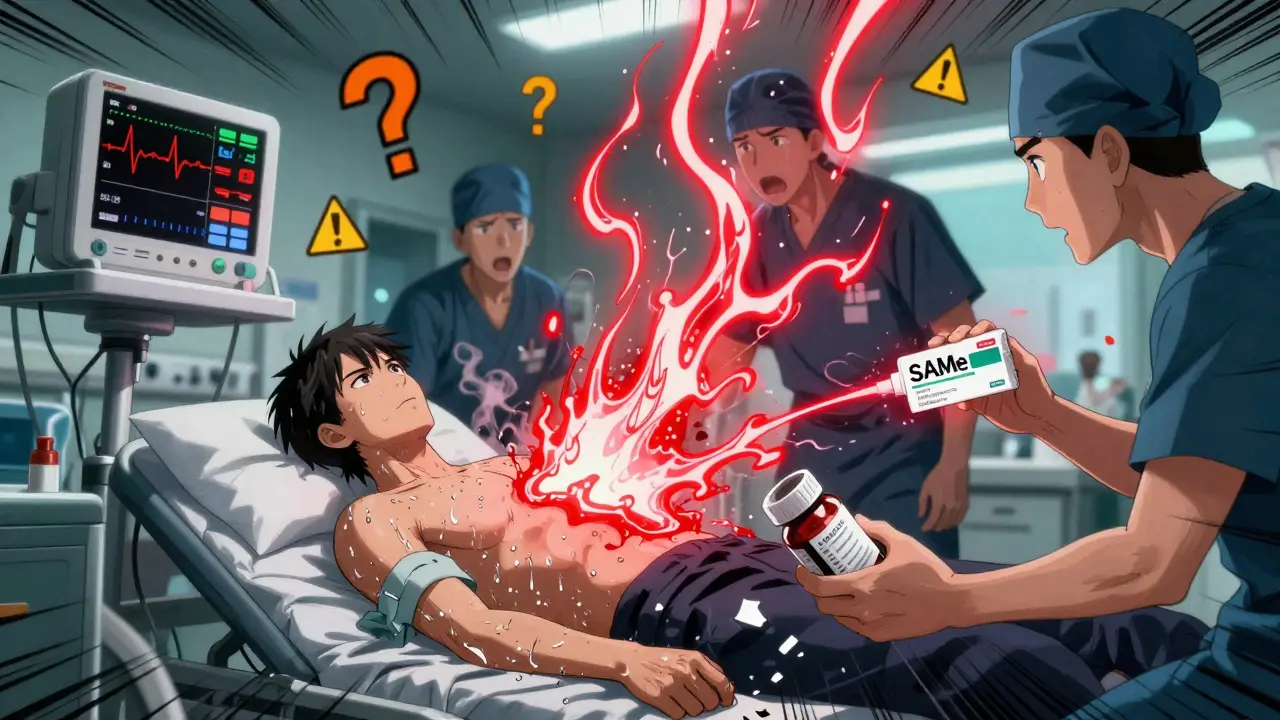
Serotonin syndrome happens when too much serotonin builds up in your nervous system. It’s rare, but deadly. Symptoms include rapid heart rate, high blood pressure, muscle rigidity, tremors, sweating, confusion, fever, and in severe cases, seizures or loss of consciousness. The Hunter Criteria - used by doctors to diagnose it - include spontaneous clonus, inducible clonus with agitation, or ocular clonus with fever.
SAMe increases serotonin production. Antidepressants like SSRIs and SNRIs prevent serotonin from being cleared away. Together, they create a perfect storm. The Mayo Clinic, the Natural Medicines Database, and the American Psychiatric Association all warn against combining them. The interaction is rated a “Major - Use Caution” with a severity score of 7.3 out of 10.
It’s not theoretical. Between 2000 and 2022, only 12 published case reports exist - but that’s because most cases go unreported. Reddit user u/DepressionWarrior2020 described racing heart, muscle stiffness, and confusion after starting 400mg SAMe with 20mg Prozac. They ended up in the ER. The FDA’s Adverse Event Reporting System logged 32 cases involving SAMe and antidepressants between 2018 and 2022, with 9 classified as serious - including two confirmed serotonin syndrome cases.
Who Should Avoid SAMe Altogether
Not everyone benefits from SAMe. It doesn’t work well for severe depression, especially melancholic or psychotic types. In one trial, remission rates were only 18% compared to 42% with venlafaxine. If you’ve been told your depression is “treatment-resistant,” that doesn’t automatically mean SAMe is the answer.
It also doesn’t work for everyone physically. Around 28% of users report stomach upset - nausea, gas, bloating. Some feel more anxious at first. A 2019 study found 22% of users experienced increased anxiety in the first week before improvement. That’s why doctors recommend starting low: 200mg twice daily, and increasing slowly over 5-7 days.
And if you’re bipolar? Avoid SAMe entirely. There’s strong evidence it can trigger mania or hypomania. The American Psychiatric Association explicitly advises against it in bipolar disorder.
Quality Issues and Hidden Risks
Here’s another problem: you don’t know what you’re actually taking.
SAMe is sold as a dietary supplement, not a drug. That means manufacturers don’t need to prove it works before selling it. The FDA doesn’t test it. In 2022, ConsumerLab.com tested 15 SAMe products and found 32% contained 15-25% less active ingredient than labeled. That’s not just ineffective - it’s misleading. You might think you’re taking 800mg, but you’re getting 600mg. Or worse, you’re getting 400mg of filler.
And the packaging? Only 37% of products include clear interaction warnings, according to a 2021 JAMA Internal Medicine study. You might buy a bottle thinking it’s safe to mix with your Zoloft - because the label doesn’t say otherwise.
Even storage matters. SAMe breaks down quickly if not kept cold. Most products require refrigeration at 2-8°C. If it’s been sitting on a hot shelf in a warehouse or your bathroom cabinet, it might be useless - or worse, degraded into harmful byproducts.
What to Do If You’re Already Taking Both
If you’re currently taking SAMe and an antidepressant - stop immediately. Don’t quit cold turkey. But don’t keep going without talking to your doctor.
Call your psychiatrist or primary care provider. Ask for a review of your symptoms. Are you experiencing any of these: unusual sweating, muscle twitching, rapid heartbeat, confusion, fever? If yes, go to urgent care. Don’t wait. Serotonin syndrome can escalate in hours.
If you’re symptom-free and want to continue, ask your doctor to monitor you closely. They should check your blood pressure, heart rate, and mental status weekly for the first month. Start with the lowest possible dose - 200mg twice daily - and never exceed 800mg daily without supervision. Take it with food to reduce nausea. Split doses to avoid insomnia.
And never buy SAMe from Amazon, Walmart, or random online sellers without third-party testing. Look for brands that are USP-verified or have been independently tested by ConsumerLab or Labdoor. Even then, assume the dose might be off.
The Bottom Line
SAMe isn’t a miracle cure. It’s not even a safe add-on for most people. The science shows it can help - but only in specific cases, and only under strict medical supervision. The risks, especially when mixed with antidepressants, are real and potentially life-threatening.
If you’re considering SAMe, talk to your doctor first. Not your friend on Reddit. Not the supplement store clerk. A licensed professional who knows your full medical history.
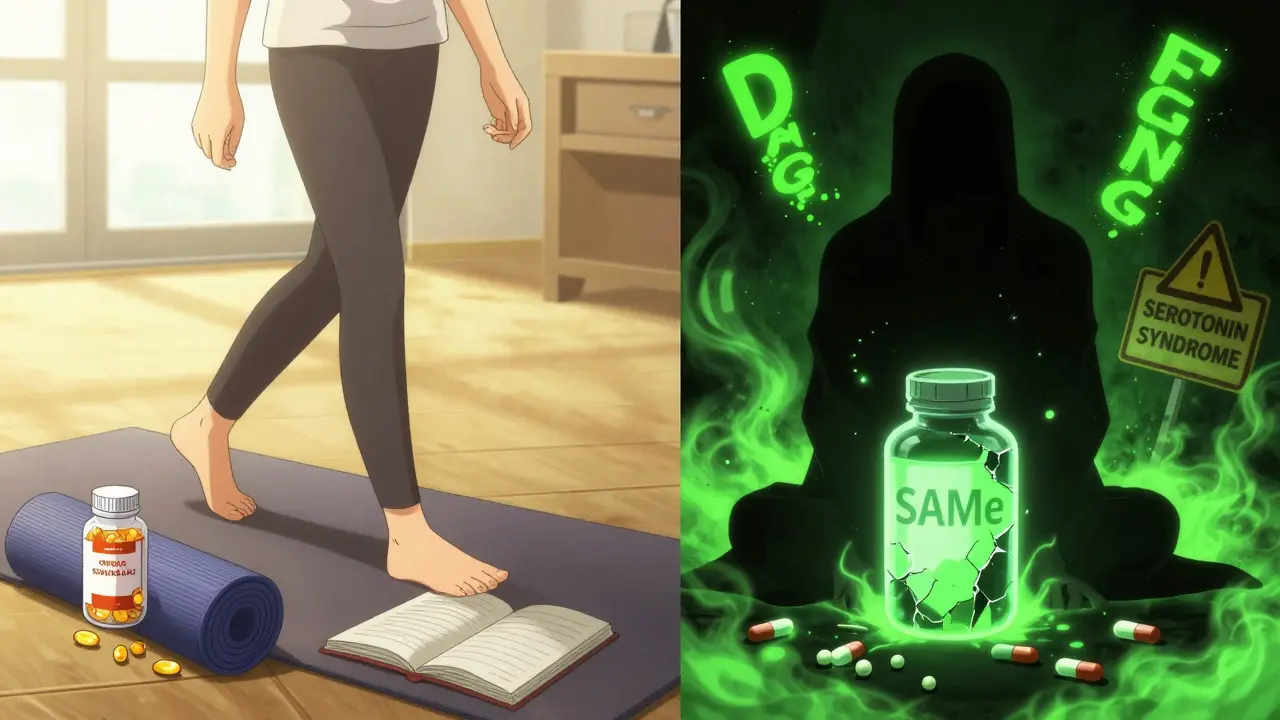
There are safer ways to boost antidepressant effectiveness - therapy, exercise, sleep hygiene, omega-3s, even light therapy. SAMe might seem like a quick fix, but it’s a gamble with your nervous system. And right now, the odds aren’t in your favor.
Can I take SAMe with SSRIs like Prozac or Zoloft?
It’s not recommended. Combining SAMe with SSRIs increases the risk of serotonin syndrome - a potentially life-threatening condition. Even if you feel fine at first, symptoms can appear suddenly. The Mayo Clinic and Natural Medicines Database both classify this interaction as "Major - Use Caution." Only consider this combination under close medical supervision, and never without discussing it with your doctor first.
How fast does SAMe work for depression?
SAMe can start working faster than traditional antidepressants - some people notice mood improvements in 7 to 10 days. This is because it boosts neurotransmitter production directly, rather than just blocking reuptake like SSRIs. But faster doesn’t mean better. Its overall effectiveness is lower than SSRIs, especially in moderate to severe depression.
Is SAMe better than antidepressants?
No. SAMe is not a replacement for antidepressants. Studies show it helps about 35-50% of people with mild-to-moderate depression, compared to 60-70% for SSRIs. It’s less effective in severe cases and has no proven benefit for bipolar depression. It’s sometimes used as an add-on, not a standalone treatment.
What are the side effects of SAMe?
Common side effects include nausea, gas, bloating, and insomnia. About 22% of users report increased anxiety in the first week. Taking SAMe with food can reduce stomach upset in 65% of cases. Splitting doses helps with sleep issues. Rare but serious side effects include serotonin syndrome when combined with antidepressants, and mania in people with bipolar disorder.
Does SAMe really help with joint pain too?
Yes. SAMe has been shown to reduce pain and stiffness in osteoarthritis, sometimes as effectively as NSAIDs like ibuprofen. One study found patients on SAMe plus duloxetine had 30% more pain relief than those on duloxetine alone. This dual benefit makes it appealing for people with both depression and chronic pain - but doesn’t make it safer to combine with antidepressants.
Are all SAMe supplements the same?
No. A 2022 ConsumerLab test found 32% of SAMe products contained significantly less active ingredient than labeled. Some were as low as 15% below the stated dose. Many don’t require refrigeration on the label, but SAMe degrades quickly without cold storage. Look for USP-verified brands or those tested by independent labs like Labdoor. Avoid cheap Amazon brands - quality control is poor.
Should I stop SAMe before surgery?
Yes. SAMe can affect blood clotting and interact with anesthesia. Most surgeons recommend stopping all supplements, including SAMe, at least 1-2 weeks before surgery. Always tell your anesthesiologist and surgeon about everything you’re taking - even if it’s "just a supplement."


