
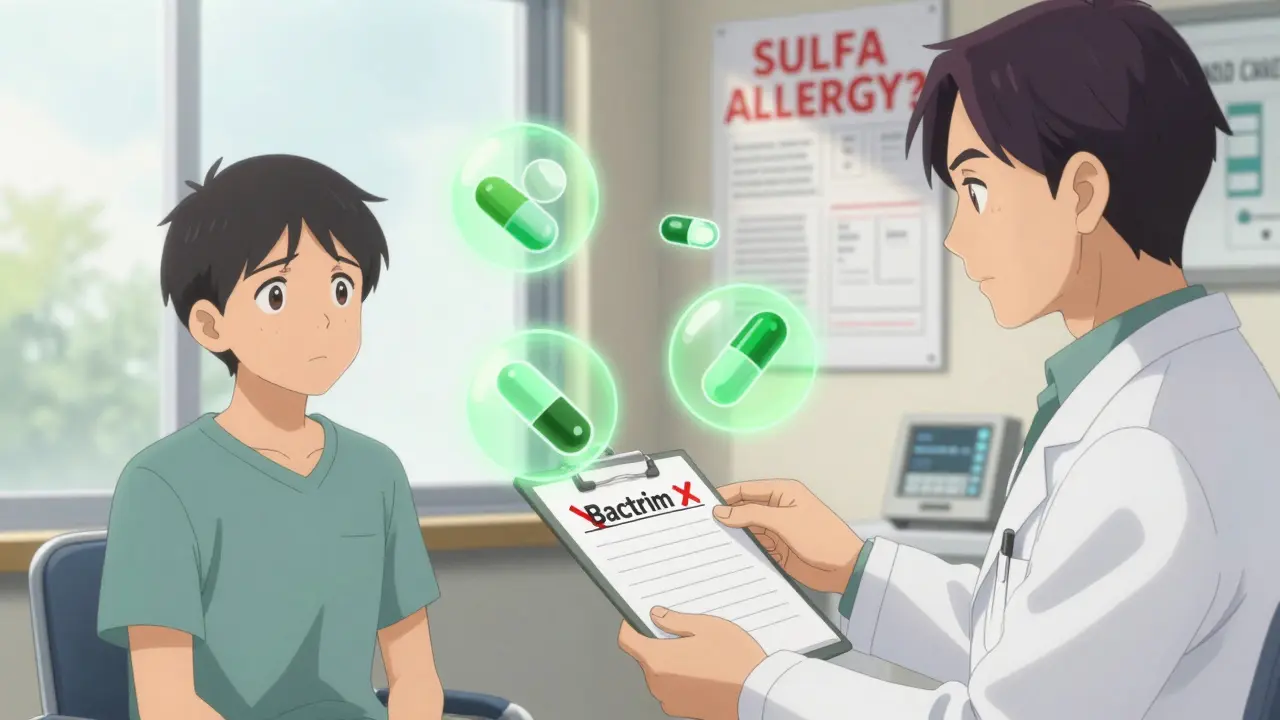
Sulfonamide Drug Safety Checker
This tool helps you determine which sulfonamide drugs are safe to take based on your reported allergy history. Most people with a "sulfa allergy" can safely take nonantimicrobial sulfonamides like hydrochlorothiazide and celecoxib.
Your Allergy History
Results
Most people who say they have a "sulfa allergy" don’t actually need to avoid all drugs with "sulf" in the name. The confusion is widespread, and it’s costing patients better care - and the healthcare system billions. A 2022 study found that 3 to 12% of people report a sulfa allergy, but less than half a percent have a true IgE-mediated reaction. The rest? Often just a mild rash that happened years ago, or a side effect mistaken for an allergy. And because of this, doctors avoid giving them safe, effective antibiotics - and instead reach for broader-spectrum drugs that carry bigger risks.
What Exactly Is a Sulfonamide Allergy?
The term "sulfa allergy" usually refers to an allergic reaction to sulfonamide antibiotics. These include drugs like sulfamethoxazole (often paired with trimethoprim as Bactrim or Septra), sulfadiazine, and sulfacetamide. They were among the first antibiotics ever developed, dating back to the 1930s. But here’s the key: not all drugs with "sulf" in the name are the same.The problem isn’t the sulfur atom. It’s not about sulfates (like magnesium sulfate) or sulfites (used in wine and dried fruit). Those are chemically unrelated. The real issue is a specific molecular structure: an aromatic amine group attached at the N4 position of the sulfonamide ring. That’s what makes antimicrobial sulfonamides capable of triggering immune reactions in some people.
Nonantimicrobial sulfonamides - like hydrochlorothiazide (for high blood pressure), furosemide (a water pill), celecoxib (Celebrex), and acetazolamide (for glaucoma or altitude sickness) - don’t have that same structure. They’re built differently. And that difference matters a lot.
What You Can Still Take: The Big Myth Busted
If you’ve been told to avoid all "sulfa" drugs because of a past reaction, you might be missing out on safe, effective treatments. Here’s what the evidence says:- Hydrochlorothiazide: Used by millions for high blood pressure. Studies show the risk of reaction in people with a history of sulfonamide antibiotic allergy is about 1.1% - almost identical to people without any sulfa allergy history.
- Furosemide: This loop diuretic has no clinically meaningful cross-reactivity. A 2020 analysis of over 10,000 patients found no increased risk.
- Celecoxib: The only COX-2 inhibitor available as a generic. It’s structurally different and safe for most people with sulfonamide antibiotic allergies.
- Acetazolamide: Used for glaucoma, epilepsy, and altitude sickness. No evidence of cross-reactivity.
A 2021 study in JAMA Internal Medicine followed 10,256 people with "sulfa allergy" labels. Only 1.3% had any reaction to nonantimicrobial sulfonamides - and that’s nearly the same rate as people without the label. That’s not a signal of cross-reactivity. It’s noise.
Yet, patients are still being denied these drugs. One patient on Reddit shared that for 10 years, his doctor refused to prescribe hydrochlorothiazide for his hypertension because of a childhood rash. He ended up on three other medications with worse side effects - dizziness, fatigue, and kidney strain. That’s not just inconvenient. It’s dangerous.
What You Should Still Avoid
Not all sulfonamides are created equal. You should still avoid antimicrobial sulfonamides if you’ve had a confirmed allergic reaction to one. That includes:- Sulfamethoxazole-trimethoprim (Bactrim, Septra)
- Sulfadiazine
- Sulfasalazine (used for ulcerative colitis and rheumatoid arthritis)
- Sulfacetamide (eye drops or creams)
- Sulfanilamide (older topical use)
And there’s one exception: dapsone. It’s used to prevent Pneumocystis pneumonia in people with HIV, and it shares structural similarities with antimicrobial sulfonamides. Studies show a 13% reaction rate in those with prior sulfonamide antibiotic allergies. If you need dapsone and have a history of reaction, you should be evaluated by an allergist first.
Why This Matters: The Real Cost of Mislabeling
When doctors avoid sulfonamide antibiotics because of a mislabeled allergy, they turn to alternatives - often broader-spectrum drugs like fluoroquinolones (Cipro, Levaquin). These carry black box warnings from the FDA for tendon rupture, nerve damage, and aortic aneurysm. They’re also major drivers of antibiotic resistance.A 2021 study showed that patients labeled with "sulfa allergy" get broader antibiotics 78% of the time - and 33% of those are unnecessary. The CDC reports this practice increases resistance rates in common bacteria like E. coli by over 8%, and Staphylococcus aureus by nearly 13%. That’s not just a personal risk. It’s a public health problem.
The financial toll is just as bad. In the U.S. alone, inappropriate avoidance of sulfonamide antibiotics costs the healthcare system $1.2 billion annually in extra drugs, longer hospital stays, and complications from worse alternatives.

What to Do If You Think You Have a Sulfa Allergy
If you’ve been told you have a sulfa allergy - especially if it was years ago, or it was just a mild rash - here’s what you should do:- Look at your history. Did you have a fever, blistering skin, swelling, trouble breathing, or a drop in blood pressure? Those are signs of a true allergic reaction. A mild rash that appeared after five days of taking Bactrim? That’s often not an allergy - it’s a common side effect.
- Ask for clarification. Don’t just say "I’m allergic to sulfa." Say: "I had a rash on day 5 after taking sulfamethoxazole. No swelling, no breathing issues." That helps your doctor judge the risk.
- Consider an evaluation. If you’ve been avoiding blood pressure or glaucoma meds because of a past reaction, talk to an allergist. Graded oral challenges - where you take small, increasing doses under supervision - are safe and accurate. One study showed 94.7% of people with reported sulfa allergies tolerated the challenge.
- Get your record updated. If testing shows you’re not allergic, ask your doctor to remove the "sulfa allergy" label from your chart. That simple step can change your future care.
What Your Doctor Needs to Know
Many doctors still believe all sulfonamides are cross-reactive. That’s outdated. The American Academy of Allergy, Asthma & Immunology (AAAAI) updated its guidelines in 2023 to clearly state: "There is no clinically significant immunologic cross-reactivity between sulfonamide antibiotics and nonantibiotic sulfonamides."Electronic health record systems like Epic now have built-in alerts that differentiate between antimicrobial and nonantimicrobial sulfonamides. But they’re only as good as the data entered. If your chart says "sulfa allergy" without details, the system will block everything.
Doctors need to stop using "sulfa allergy" as a blanket term. They need to document the specific drug, the reaction, and the timing. A note like "maculopapular rash 5 days after sulfamethoxazole-trimethoprim" is far more useful than "allergic to sulfa."
What About Sulfur, Sulfates, and Sulfites?
This is a big source of confusion. People think if they’re allergic to sulfa, they can’t have anything with "sulf" in it. That’s wrong.- Sulfur is an element. It’s in your skin, hair, and every cell in your body. You can’t be allergic to it.
- Sulfates (like magnesium sulfate or sodium lauryl sulfate) are salts. They’re in Epsom salts, shampoos, and IV fluids. No cross-reactivity.
- Sulfites are preservatives in wine, dried fruit, and some medications. They can trigger asthma in sensitive people - but that’s a different mechanism entirely. No link to sulfonamide allergies.
A 2020 survey found 43% of primary care doctors wrongly believed sulfites were unsafe for sulfa-allergic patients. That’s not just a gap in knowledge - it’s a risk to patients.
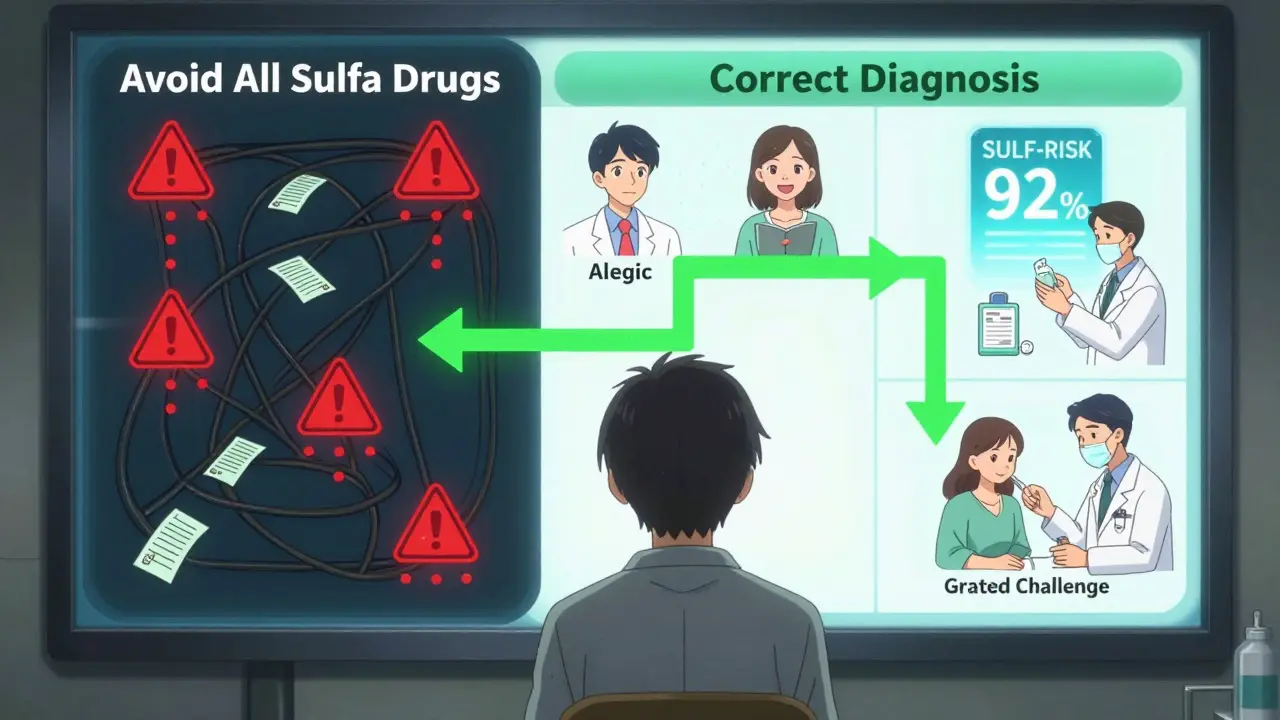
The Future: Better Testing, Fewer Mistakes
New tools are coming. In 2022, researchers developed the SULF-RISK score - a simple tool that uses patient history to predict who’s likely to have a true allergy. It’s 92% accurate. By 2025, most major health systems are expected to use automated alerts that flag only high-risk cases.There’s also a new blood test in Phase II trials for sulfamethoxazole-specific IgE. It’s showing 89.7% accuracy. That could mean one day, instead of guessing, we’ll know for sure.
But the biggest change won’t come from a lab. It’ll come from patients asking questions. From doctors listening. From charts being updated.
Frequently Asked Questions
Can I take hydrochlorothiazide if I have a sulfa allergy?
Yes, most people can. Hydrochlorothiazide is a nonantimicrobial sulfonamide and does not share the chemical structure that causes allergic reactions to sulfonamide antibiotics. Studies show the risk of reaction is no higher than in people without any sulfa allergy history. If you’ve had only a mild rash in the past, a supervised oral challenge is safe and often confirms tolerance.
Is celecoxib safe for someone with a sulfa allergy?
Yes. Celecoxib (Celebrex) is a nonantimicrobial sulfonamide. It lacks the N4-arylamine group that triggers immune reactions in sulfonamide antibiotics. Multiple studies involving thousands of patients show no increased risk of reaction. It’s routinely used in patients with documented sulfa antibiotic allergies.
What’s the difference between sulfa allergy and sulfite allergy?
They’re completely different. Sulfa allergy involves the immune system reacting to specific antibiotic drugs. Sulfite allergy (or sensitivity) is usually a respiratory reaction to preservatives in food or wine - often in people with asthma. The chemicals involved are unrelated. Being allergic to one doesn’t mean you’re allergic to the other.
Can I take Bactrim again if I had a rash once?
Not without evaluation. A rash that appeared after 5 days of Bactrim is often a non-allergic side effect, not a true allergy. But if you had blistering skin, fever, swelling, or trouble breathing, that’s serious. See an allergist for testing before considering re-exposure. For mild rashes, a supervised oral challenge can confirm whether it’s safe.
Why do some doctors still avoid all sulfa drugs?
Many doctors learned outdated information. Until recently, medical training taught that all sulfonamides cross-react. Guidelines changed in 2023, but old habits persist. Electronic health records also contribute - if your chart just says "sulfa allergy," the system blocks everything. That’s why clear documentation and patient advocacy matter.