

Dechallenge Timeline Calculator
This tool estimates whether symptom improvement after stopping a medication matches expected resolution timing based on the drug's half-life. Note: This is for informational purposes only and should not replace professional medical advice.
When a patient starts feeling worse after taking a new medication, doctors don’t just assume it’s the drug’s fault. They need proof. That’s where dechallenge and rechallenge come in-two simple but powerful clinical tests that help separate real drug side effects from coincidence.
What Is Dechallenge?
Dechallenge is the first step: stop the drug and see what happens. If the strange symptom-like a rash, dizziness, or nausea-gets better after you stop taking the medicine, that’s a positive dechallenge. It suggests the drug was likely the cause.It sounds obvious, but it’s not always that simple. Some side effects take days or even weeks to fade. A rash from an antibiotic might linger for a fortnight after stopping the pill. A liver enzyme spike from a cholesterol drug might not drop until after two weeks. That’s why timing matters. A good dechallenge looks at the drug’s half-life-how long it stays in your body-and matches symptom improvement to that timeline.
For example, if someone develops a severe skin reaction after taking metronidazole, and the rash clears up within 72 hours of stopping the drug, that’s strong evidence. If the rash stays the same or gets worse? Then it’s probably not the drug. Maybe it’s an infection, an allergy to something else, or even stress.
But here’s the catch: patients often stop meds on their own. They feel bad, so they quit. That’s not a proper dechallenge. Without medical supervision, you don’t know if the timing was right, or if other drugs were stopped at the same time. In polypharmacy-when someone takes five or more pills-a dechallenge can get messy. Which drug caused it? You can’t tell if you stopped them all at once.
What Is Rechallenge?
Rechallenge is the next step: give the drug back. If the same side effect comes back exactly as before, you’ve got near-conclusive proof.This is the gold standard. In dermatology, a fixed-drug reaction-where a rash always shows up in the same spot on the skin-can be confirmed by rechallenge. One case study showed a patient getting the exact same blistering rash in the same spot on their ankle, just two days after restarting metronidazole after a three-month break. That’s not random. That’s a signature.
But here’s the problem: rechallenge is risky. If the side effect was liver failure, Stevens-Johnson syndrome, or a dangerous drop in blood pressure, giving the drug back could kill someone. That’s why it’s rarely done. In fact, less than 0.3% of serious adverse drug reaction cases involve deliberate rechallenge, according to FDA data.
Doctors only consider it when:
- The reaction was mild or moderate
- The drug is essential (like an anticonvulsant for epilepsy)
- The patient gives full informed consent
- The test is done in a hospital with emergency support ready
Most of the time, doctors skip rechallenge. They rely on dechallenge alone. But even then, dechallenge is only considered “probable” causality. Rechallenge bumps it to “definite.” The World Health Organization’s pharmacovigilance system uses this distinction to decide if a drug needs a warning label or a black box alert.
Why These Tests Matter Beyond the Clinic
Dechallenge and rechallenge aren’t just for individual patients. They’re the backbone of global drug safety systems.When a new drug hits the market, thousands of people take it. Rare side effects don’t show up in clinical trials because those trials involve only a few thousand people. But once millions are using the drug, strange reactions pop up. That’s where pharmacovigilance kicks in.
Regulators like the FDA and EMA require pharmaceutical companies to analyze dechallenge and rechallenge reports from doctors and patients. If enough cases show the same pattern-say, a certain antidepressant causing tremors that vanish when stopped and return when restarted-that drug gets a new warning. Sometimes, it gets pulled.
In dermatology, over 87% of adverse drug reaction assessments include dechallenge data. In liver injury cases, it’s 79%. But in psychiatry? Only 43%. Why? Because stopping an antipsychotic or mood stabilizer can trigger psychosis or suicidal thoughts. The risk of stopping is too high, so doctors avoid dechallenge. That creates a blind spot in the data.
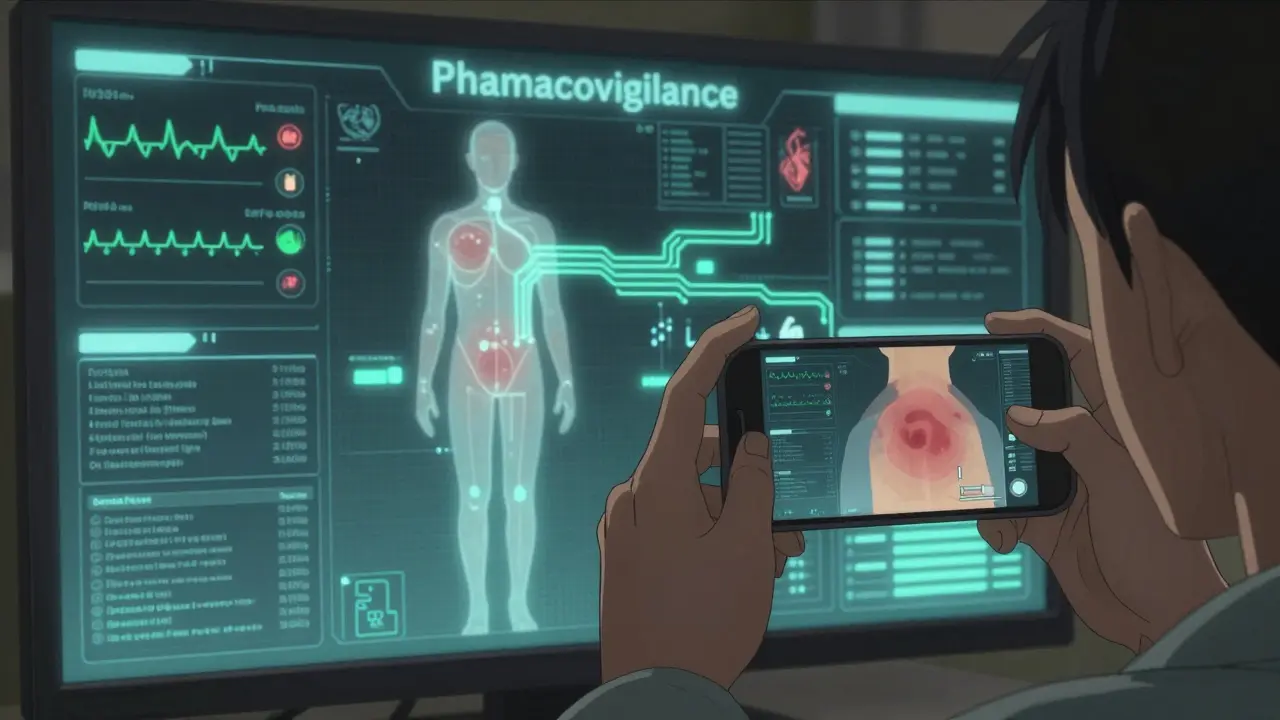
That’s why companies are now using digital tools. Wearable sensors track heart rate, skin temperature, and sleep patterns during dechallenge. Instead of relying on a patient saying “I feel better,” doctors get objective data: did their cortisol levels drop? Did their rash’s redness fade on camera? One 2023 study showed these sensors improved detection accuracy from 52% to 78%.

The Limits of Algorithms and Why Human Judgment Still Wins
There are scoring systems like the Naranjo scale that assign points for things like timing, whether the reaction is known, and whether dechallenge happened. But these are just tools. They can’t replace real-world observation.A machine learning model might predict a 76% chance that a certain rash will resolve after stopping a drug. But if the patient’s rash didn’t improve after five days, the algorithm is wrong. No algorithm sees the patient. No algorithm notices the subtle shift in skin texture, the way the swelling goes down after midnight, or the patient’s tone when they say, “I haven’t felt this calm in months.”
Dr. Elena Rodriguez from the WHO put it best: “No algorithm can substitute for the clinical reality of symptom resolution after drug discontinuation.” Dechallenge is a human act. It requires listening, observing, and trusting the patient’s experience.
What You Can Do as a Patient
You don’t need to be a doctor to use these principles. If you suspect a drug is causing side effects:- Don’t stop cold turkey unless your doctor says so-some meds need to be tapered.
- Write down exactly when the side effect started and what you were taking.
- Take photos of rashes or swelling. They help doctors track progress.
- Ask: “If I stop this, what should I expect? How long will it take to clear?”
- If you’re asked to rechallenge, ask why. What are the risks? What happens if it goes wrong?
Many side effects are reversible. But only if you catch them early and track them properly.
What’s Changing in Pharmacovigilance
The future of dechallenge and rechallenge isn’t about doing more rechallenges-it’s about avoiding them safely.Scientists are developing blood tests that check for immune markers before re-exposure. If your lymphocytes react strongly to the drug in a lab dish, you’re likely to have a bad reaction again. These tests are 89% accurate in early trials.
Regulators now require all electronic adverse event reports to include dechallenge outcomes. In 2024, the ICH E2B(R3) guidelines made it mandatory. That means if you report a side effect, your doctor has to answer: “Did you stop the drug? Did it improve?”
Pharmaceutical companies are investing heavily in this. Eighty-two percent of major drugmakers now require dechallenge data in post-market safety studies. Why? Because lawsuits cost billions. Proving a drug caused harm without solid dechallenge evidence is nearly impossible in court.
Final Thought: It’s Not Magic-It’s Observation
Dechallenge and rechallenge aren’t high-tech procedures. They don’t need machines or labs. They just need time, patience, and careful attention.They’re the oldest and most reliable way to answer one simple question: “Did this drug cause this problem?”
For every patient who gets a rash, a headache, or a strange feeling after starting a new pill, the answer isn’t in a textbook. It’s in what happens when you take the pill away-and sometimes, when you put it back.
Can dechallenge prove a drug caused my side effect?
Dechallenge can strongly suggest a drug caused a side effect-if symptoms improve after stopping the medication. But it doesn’t prove it 100%. Other factors like illness, stress, or other drugs can also cause symptoms to change. Dechallenge is considered "probable" causality. For "definite" proof, rechallenge is needed.
Is rechallenge safe to do?
Rechallenge is rarely done because it carries risk. If the original side effect was life-threatening-like liver failure, severe skin reactions, or heart problems-re-exposing you to the drug could be dangerous. It’s only considered for mild reactions, under strict medical supervision, with full consent and emergency support ready. Less than 0.3% of serious cases involve rechallenge.
Why don’t doctors always do dechallenge?
Sometimes, stopping the drug isn’t safe. For example, if you’re on an anticonvulsant for epilepsy, stopping it suddenly could trigger a seizure. In psychiatric cases, stopping antidepressants can cause withdrawal or relapse. Also, patients often stop meds on their own, which makes dechallenge unreliable. Doctors need clear timing and controlled conditions to interpret results properly.
How long should I wait after stopping a drug to see if the side effect goes away?
It depends on the drug. For drugs with a short half-life (like ibuprofen), symptoms may improve in 1-3 days. For drugs that stay in your system longer (like fluoxetine or some antibiotics), it can take 1-2 weeks. Doctors use the drug’s known elimination time to set expectations. If symptoms don’t improve within that window, the drug is less likely to be the cause.
Can wearable tech replace dechallenge?
Wearables help-they can track heart rate, skin temperature, or sleep patterns objectively. But they don’t replace the patient’s report. A sensor might show your inflammation is lowering, but only you can say if your nausea is gone or your energy returned. Dechallenge is about the full picture: how you feel, not just what the device measures. Tech supports, but doesn’t substitute, clinical observation.


