

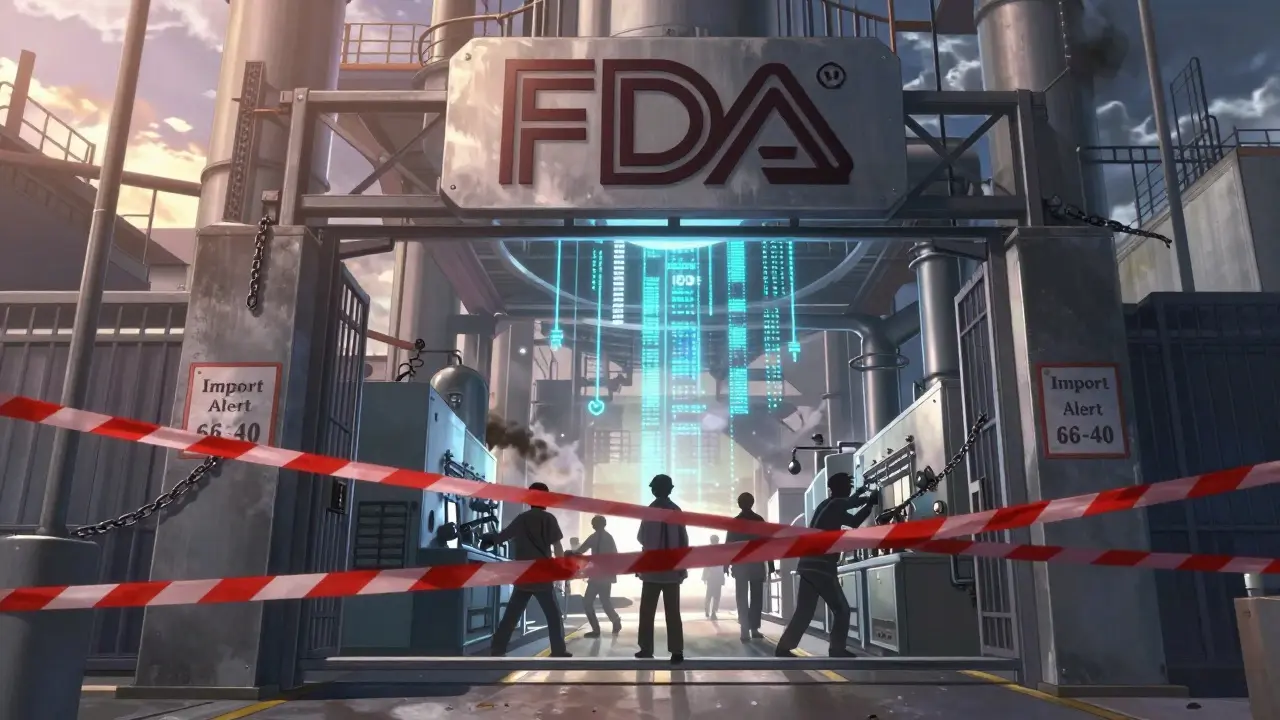
The FDA doesn’t just approve drugs and devices - it watches every step of how they’re made. In 2025, the agency issued 32% more warning letters for quality system failures in medical device manufacturing compared to 2024. That’s not random. It’s a signal: if your factory isn’t doing the basics right, your products won’t reach U.S. patients. And it’s not just about fines. Facilities with critical violations are now blocked from importing into the U.S. without physical inspection - 147 factories sit on Import Alert 66-40 as of November 2025. These aren’t edge cases. They’re systemic failures that put lives at risk.
Aseptic Processing: The Silent Killer in Clean Rooms
One of the most common and dangerous failures the FDA finds is in aseptic processing. This is where sterile drugs - like IV solutions, injectables, and eye drops - are made without contamination. The FDA cited this issue in 47% of 2025 warning letters. What does that look like in real life?
One company, Health and Natural Beauty USA Corp., got a warning letter in July 2025 because their media fill studies - the test that proves your sterile process works - were outdated and incomplete. Another, Creative Essences, Inc., failed to keep their clean room at the right pressure during production. Airflow should push contaminants out. If it doesn’t, bacteria or fungi can get into a vial of insulin or a chemotherapy drug.
These aren’t theoretical risks. The 2007-2009 heparin contamination crisis killed 84 people because of a toxic impurity that slipped through untested raw materials. Since then, the FDA has made sterile process controls non-negotiable. If you can’t prove your clean room works every single day, your product won’t get approved.
Data Integrity: When Records Are Faked or Missing
“We didn’t write down what we did” isn’t an excuse - it’s a violation. Data integrity failures appeared in 39% of 2025 warning letters. That means more than a third of the companies the FDA inspected couldn’t prove their products met standards because their records were incomplete, altered, or missing.
Guangxi Yulin Pharmaceutical Group Co. Ltd. got flagged because their UV-Vis and IR instruments had no audit trails. That means no one could tell who changed a result, when, or why. Another company used laminated paper batch records with erasable markers - a classic red flag. You can’t erase a batch record and pretend it never happened. The FDA requires ALCOA+: data must be Attributable, Legible, Contemporaneous, Original, and Accurate - plus Complete, Consistent, Enduring, and Available.
Electronic systems aren’t the fix by themselves. If you give 10 people the same login, or don’t lock down who can change results, you’re just digitizing the problem. The FDA now requires audit trails to retain data for at least 180 days, with user-specific access and sequential timestamps. No exceptions.
Material Control: Bad Ingredients, Bad Outcomes
Garbage in, garbage out. That’s the rule the FDA enforces on raw materials. In 35% of warning letters, companies failed to properly test incoming ingredients. One case involved glycerin and sorbitol - common ingredients in toothpaste and cough syrup - that weren’t tested for diethylene glycol (DEG), a toxic chemical linked to kidney failure and death.
Health and Natural Beauty USA Corp. was cited for not testing these materials at the required sensitivity level: 0.1% w/w. That’s one part in a thousand. If you’re not checking that precisely, you’re gambling with patient safety. Another company, Foshan Yiying Hygiene Products Co., didn’t verify if their suppliers were actually doing the tests they claimed to do. The FDA doesn’t trust supplier certificates alone. You have to test. Or you have to prove your supplier’s testing is reliable - through audits, sample testing, or third-party validation.
USP General Chapter <1085> lays out the standards. If you’re making anything that goes into the body, you need to know what’s in every batch of every ingredient. No shortcuts.

Process Validation: Proving It Works - Not Just Saying It Does
Just because you’ve made a product for years doesn’t mean you’ve validated it. The FDA found process validation gaps in 28% of 2025 warning letters. One company made toothpaste for years but never ran a single validation study to prove their mixing, filling, or sealing process consistently met quality specs. Another didn’t establish scientifically sound analytical methods to test active ingredients.
Validation isn’t a one-time checkbox. It requires three consecutive successful batches - each one tested at every step - with results meeting pre-set criteria. The FDA’s 2022 Process Validation Guidance is clear: you must understand your process, control your variables, and prove consistency. If your process changes - a new machine, different supplier, new location - you have to re-validate.
Companies that skip this think they’re saving time. In reality, they’re setting up a recall, a warning letter, or worse - a lawsuit.
Quality Culture: The Root Cause Behind Every Failure
Here’s the truth most companies don’t want to hear: technical failures are symptoms. The real problem is culture. Dr. David Lim of Compliance Architects found that 78% of facilities cited in 2025 warning letters had leadership that prioritized speed over compliance.
It shows up in small ways: a supervisor tells a technician to skip a test because “it’s always been fine.” A manager deletes an alert because it’s “just a warning.” A quality unit has no authority to stop production. Foshan Yiying’s warning letter said it plainly: “This site does not prepare batch production records for every batch.” That’s not a mistake. That’s a culture where rules are optional.
The FDA’s Quality Management Maturity (QMM) initiative, launched in January 2024, is trying to fix this. So far, 87 manufacturers have voluntarily joined. The results? Facilities with strong quality cultures see 63% fewer repeat findings and fix problems 41% faster. The FDA is moving from checking boxes to asking: “Do you actually care about quality?”
Where the Problems Are Hiding: Geographic Patterns
It’s not random where these failures happen. In 2025, 73% of FDA warning letters targeted manufacturers in China, India, and Malaysia.
Chinese facilities most often failed on analytical method validation - they didn’t prove their tests could reliably detect impurities. Indian facilities struggled with data integrity - audit trails were missing, access controls were weak. Malaysian sites had quality units with no real power. These aren’t stereotypes. They’re patterns backed by data: 28 warning letters for Chinese firms on validation, 24 for Indian firms on data, 9 for Malaysian firms on oversight.
Why? In India, the CDSCO inspects fewer than 2% of domestic facilities each year. In China, pressure to cut costs and meet deadlines often overrides compliance. The FDA knows this. That’s why unannounced inspections jumped 40% in 2025 - and 68% of those targeted Asia.
What Happens Next: Enforcement Is Getting Tougher
The FDA isn’t slowing down. In 2026, they plan to conduct 1,200 unannounced inspections - up from 850 in 2025 - and for the first time, they’ll include U.S.-based facilities. That means no more hiding behind “foreign manufacturing.”
QMM assessments, once voluntary, will now influence inspection frequency. If you’ve shown you have a mature quality system, you might get fewer visits. If you’ve shown you don’t care, expect more audits, more delays, and more blocks.
Emerging focus areas include cloud-based quality systems - 12 warning letters in 2025 cited poor controls on digital platforms - and supply chain transparency. If you outsource testing to a lab, the FDA wants to know how you’re monitoring them. And if you’re using new tech like continuous manufacturing, you better have the validation data to prove it works.
How to Fix It: What the FDA Actually Expects
Getting out of compliance isn’t about hiring a consultant (though 92% of warning letters require one). It’s about fixing the system.
- For data integrity: Install validated audit trails. Lock down user access. Keep records for 180+ days. No shared logins.
- For aseptic processing: Run media fills quarterly. Monitor airflow, pressure, and particle counts daily. Train staff like their lives depend on it - because they do.
- For materials: Test high-risk ingredients like glycerin for DEG at 0.1% sensitivity. Audit your suppliers. Don’t trust certificates.
- For process validation: Run three full batches with in-process controls. Document every step. If it changes, validate again.
- For culture: Empower your quality unit. Let them stop production. Reward honesty over speed. Make compliance part of every KPI.
Global spending on CGMP compliance hit $4.7 billion in Q3 2025 - up 12.3% year-over-year. That’s not waste. That’s insurance. One warning letter can cost more than $1 million in recalls, delays, and lost sales. Fixing culture and systems now saves far more than it costs.
What You Should Do Today
If you’re in manufacturing - whether you’re in the U.S., China, or anywhere else - ask yourself:
- Can we prove every batch meets specs - with full records?
- Do we test high-risk materials like glycerin for DEG?
- Is our quality unit empowered to shut down production?
- Do we have audit trails on every instrument?
- Have we validated our process - really validated it?
If you can’t answer yes to all five, you’re already at risk. The FDA isn’t waiting. Neither should you.
What are the most common FDA manufacturing deficiencies in 2025?
The top five deficiencies in 2025 are: aseptic processing failures (47% of warning letters), data integrity issues (39%), inadequate material controls (35%), lack of process validation (28%), and weak quality culture (78% of cited facilities). These aren’t isolated problems - they’re signs of systemic failures that put patient safety at risk.
Why does the FDA care so much about data integrity?
Data integrity is the foundation of trust. If you can’t prove what happened during manufacturing, you can’t prove your product is safe or effective. The FDA requires ALCOA+ principles: data must be attributable, legible, contemporaneous, original, accurate, complete, consistent, enduring, and available. Without it, recalls, lawsuits, and bans follow.
What happens if my facility gets on Import Alert 66-40?
Your products are blocked from entering the U.S. until you fix the issues and pass a re-inspection. You must submit a detailed corrective action plan, hire an independent CGMP consultant, and demonstrate sustained compliance for at least six months. Even then, each shipment will be physically examined - a costly and time-consuming process.
Are Chinese and Indian manufacturers targeted more by the FDA?
Yes. In 2025, 73% of FDA warning letters went to facilities in China, India, and Malaysia. Chinese firms most often failed on analytical method validation; Indian firms struggled with data integrity; Malaysian firms had weak quality unit authority. This reflects both higher production volumes and weaker local oversight - not bias. The FDA inspects based on risk, not geography.
Can I avoid an FDA warning letter by doing nothing?
No. The FDA is increasing unannounced inspections by 40% in 2025 and expanding them to U.S. facilities in 2026. Ignoring compliance doesn’t make the problem disappear - it just makes the consequences worse. Warning letters lead to import blocks, recalls, lost revenue, and legal liability. Proactive fixes are always cheaper than crisis response.
What’s the QMM program, and should I join it?
The Quality Management Maturity (QMM) program is a voluntary FDA initiative to help manufacturers build stronger quality systems. As of September 2025, 87 companies have joined. Starting in Q2 2026, QMM results may influence how often you’re inspected. If you’re serious about compliance, it’s one of the best ways to show the FDA you’re not just meeting minimums - you’re building a culture of quality.


