

Ever wonder if your students-or your patients-actually "get it"? There is a massive difference between someone nodding along and someone truly grasping a concept. When we talk about education effectiveness, we are really asking: did the knowledge actually stick, and can the person apply it in the real world? Whether you are in a classroom or a clinic, the goal is to move past the "yes, I understand" reflex and find concrete proof of learning.
The biggest hurdle in tracking generic understanding is that it's often invisible. You can't see a "concept" in a blood test or a quick chat. To solve this, we need a mix of tools that don't just test memory, but test the ability to use information. If you only rely on a final test, you're essentially performing an autopsy on the learning process-you find out what went wrong only after it's too late to fix it.
The Toolkit for Tracking Understanding
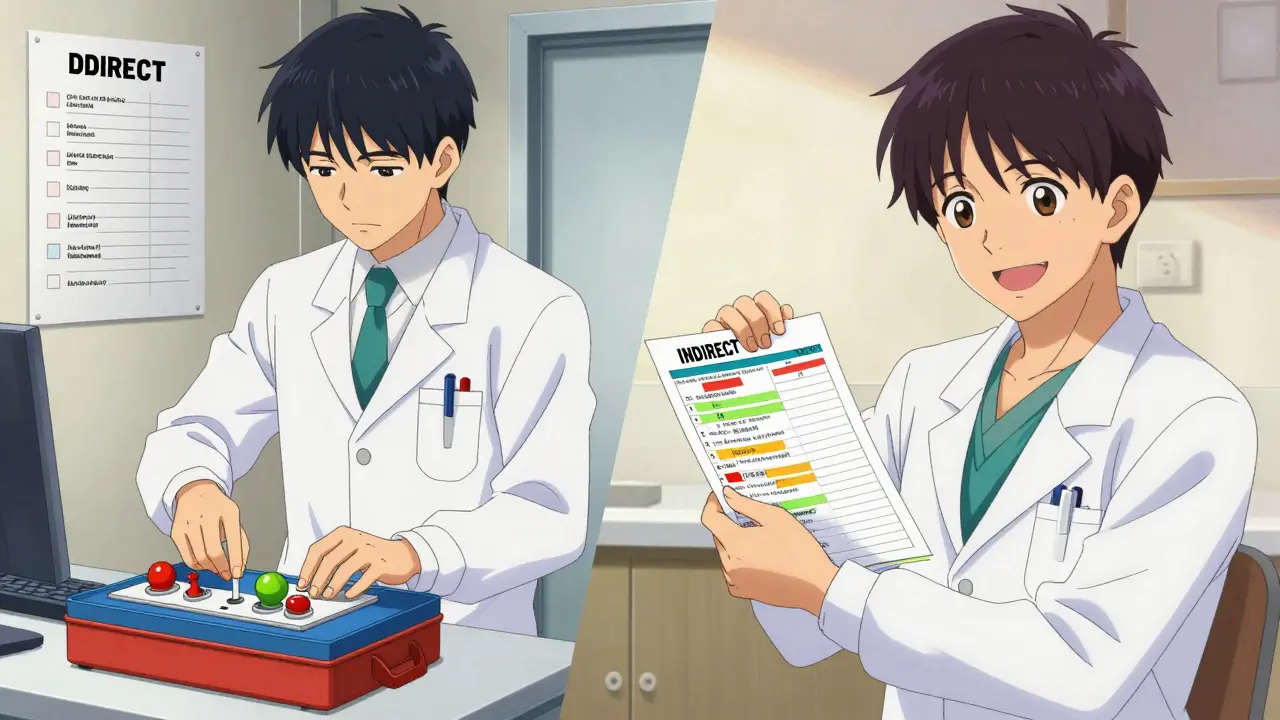
To get a full picture of how someone is progressing, you need to use different types of evidence. Experts generally split these into two camps: direct and indirect measures.
Direct Measures are assessments that document actual knowledge, skills, or behavior through tangible performance. Think of these as the "hard evidence." If you want to know if a patient understands how to manage their insulin, don't ask them if they know how; ask them to demonstrate the injection process using a trainer kit. Other examples include quizzes, case study analyses, and research projects. These provide a clear, objective data point on what the person can actually do.
Indirect Measures, on the other hand, rely on self-reporting. These are surveys, focus groups, or interviews where the person tells you how they feel about their progress. While these are great for understanding a person's confidence or perceptions, they can be misleading. A student might feel 100% confident but still fail a practical exam because confidence doesn't always equal competence.
| Feature | Direct Measures | Indirect Measures |
|---|---|---|
| Evidence Type | Objective performance/artifacts | Subjective self-reporting |
| Example | Case study, Practical demo, Quiz | Exit surveys, Alumni interviews |
| Primary Value | Proves mastery of a skill | Captures perceptions and beliefs |
| Main Weakness | Time-consuming to grade/coordinate | Low accuracy (perception $\neq$ reality) |
Formative vs. Summative: Timing is Everything
Knowing *what* to use is only half the battle; you also need to know *when* to use it. This is where the distinction between formative and summative assessment comes in.
Formative Assessment is the "check-in." It happens during the learning process. Think of it like a chef tasting the soup while it's still on the stove-they can add more salt or simmer it longer based on what they taste. In a practical sense, this looks like "exit tickets" (asking students to write the most confusing part of a lesson on a card before they leave) or quick 3-question polls. This gives you an immediate chance to pivot your teaching before the students get too far off track.
Summative Assessment is the final verdict. This is the exam at the end of the course or the final certification test. It's designed to evaluate whether the overall educational goals were met. While necessary for grading and compliance, relying solely on summative tests is risky because it doesn't provide the feedback loop needed to improve the learning experience in real-time.
Using Criterion-Referenced Standards
If you want to track generic understanding, you have to stop comparing people to each other and start comparing them to a standard. This is called Criterion-Referenced Assessment.
In a norm-referenced system, you're just looking for who is in the top 10% of the class. That's useless if the whole class is struggling. A criterion-referenced approach asks: "Does this person meet the specific standard required to perform this task safely?" For example, in medical education, it doesn't matter if a student is the "best in the class" at drawing a diagram; what matters is if they can accurately identify a symptom based on a clinical standard. This method is the only way to truly identify and close specific learning gaps.
The Power of Rubrics and Portfolios
How do you measure something like "critical thinking" or "problem-solving"? You can't do that with a multiple-choice test. This is why Rubrics are so vital. A well-constructed rubric breaks down a complex skill into specific, observable levels of performance. Instead of grading a project as "Good" or "Bad," a rubric defines exactly what "Advanced" looks like compared to "Proficient." Data shows that detailed rubrics not only make grading fairer but actually improve student performance because the expectations are crystal clear.
For a more longitudinal view, Portfolio Assessments allow learners to collect their work over time. This shows the trajectory of their understanding. Seeing a patient's journey from struggling with a basic health diary to independently managing a complex care plan provides much more insight than a single snapshot test ever could.

Common Pitfalls in Measuring Learning
Many educators fall into the trap of "survey-only" validation. They send out a survey asking, "Did you find this helpful?" and then claim the program was a success because 90% said yes. This is a mistake. People often confuse "liking the instructor" with "learning the material." To avoid this, always pair your indirect surveys with at least one direct performance measure.
Another common error is failing to align the assessment with the objective. If your goal is for someone to be able to *apply* a concept in a high-stress environment, a written test in a quiet room isn't a valid measure. You need a simulation. If the assessment doesn't mirror the real-world application, you aren't measuring understanding; you're measuring test-taking skills.
Moving Toward a Holistic Approach
The most effective systems today use a three-tiered framework: diagnostic, formative, and summative. You start by figuring out what they already know (diagnostic), check in constantly to fix mistakes (formative), and finish with a comprehensive evaluation (summative).
We are also seeing a shift toward "assessment for learning." Instead of using tests as a way to judge a student, we use them as a tool to help the student learn. By providing continuous feedback loops, learners stay engaged and are more likely to develop the transferable skills-like creativity and critical analysis-that traditional exams often miss.
What is the fastest way to track understanding during a session?
The most effective quick method is the "minute paper" or "exit ticket." Ask learners to write down the one most important thing they learned and the one thing that is still confusing. This gives you instant, actionable data on where the gaps are without needing a formal exam.
Why are indirect measures like surveys not enough?
Indirect measures capture perceptions, not performance. A person may feel they understand a concept (perceived learning) while still making critical errors in practice (actual learning). They are valuable for understanding a learner's confidence, but must be paired with direct evidence like a test or demonstration.
How do I know if my assessment is actually valid?
Check for alignment. If your learning objective is "Patient can demonstrate proper inhaler use," but your assessment is a written multiple-choice quiz about how inhalers work, your assessment is invalid. The measure must match the action required by the objective.
What is the difference between norm-referenced and criterion-referenced?
Norm-referenced compares a student against their peers (e.g., "they are in the 80th percentile"). Criterion-referenced compares a student against a fixed standard (e.g., "they can successfully perform 4 out of 5 steps of a procedure"). The latter is far better for identifying specific learning gaps.
How can rubrics improve education effectiveness?
Rubrics remove the guesswork. By defining specific criteria for success, they provide a consistent standard for grading and give learners a clear roadmap of exactly what they need to do to improve their performance.